Key points at a glance
- ✓What HACCP, GMP and CIP mean and what they require of businesses
- ✓Typical plant areas and their cleaning challenges
- ✓Validation and documentation of cleaning processes
- ✓CIP systems vs. manual cleaning: pros and cons
- ✓Choosing an experienced cleaning provider, with evidence available on request
HACCP, GMP, CIP: the three most important regulatory frameworks for equipment cleaning
HACCP (Hazard Analysis and Critical Control Points) is a food safety system that is mandatory EU-wide. It requires that all process steps, including cleaning and disinfection, are systematically analysed and controlled for risks. For cleaning this means: every plant must follow a cleaning plan that specifies frequency, agents, temperatures and contact times. Deviations must be documented and assessed.
GMP (Good Manufacturing Practice) is the regulatory framework for pharmaceuticals, medical devices and cosmetics. The EU GMP guidelines (EudraLex Vol. 4) require cleaning procedures to be validated, i.e. shown to achieve the required cleanliness reproducibly. That means: swab tests, residue measurements, documented measurement series and an approved standard operating procedure (SOP) for each system.
CIP (Cleaning-in-Place) is a cleaning principle in which the plant is cleaned without being fully dismantled. Cleaning and disinfecting agents are flushed through the piping system, tanks and process lines. CIP systems are standard in dairies, breweries, fruit juice plants and pharmaceutical production facilities. They allow high cleaning frequency with minimal downtime, but require regular maintenance and calibration of the spray heads and valves.
Typical plant areas and their specific cleaning challenges
Not every plant is equally hard to clean. The challenges vary considerably depending on the process, medium and plant design:
Tanks and vessels (food, pharma, chemicals)
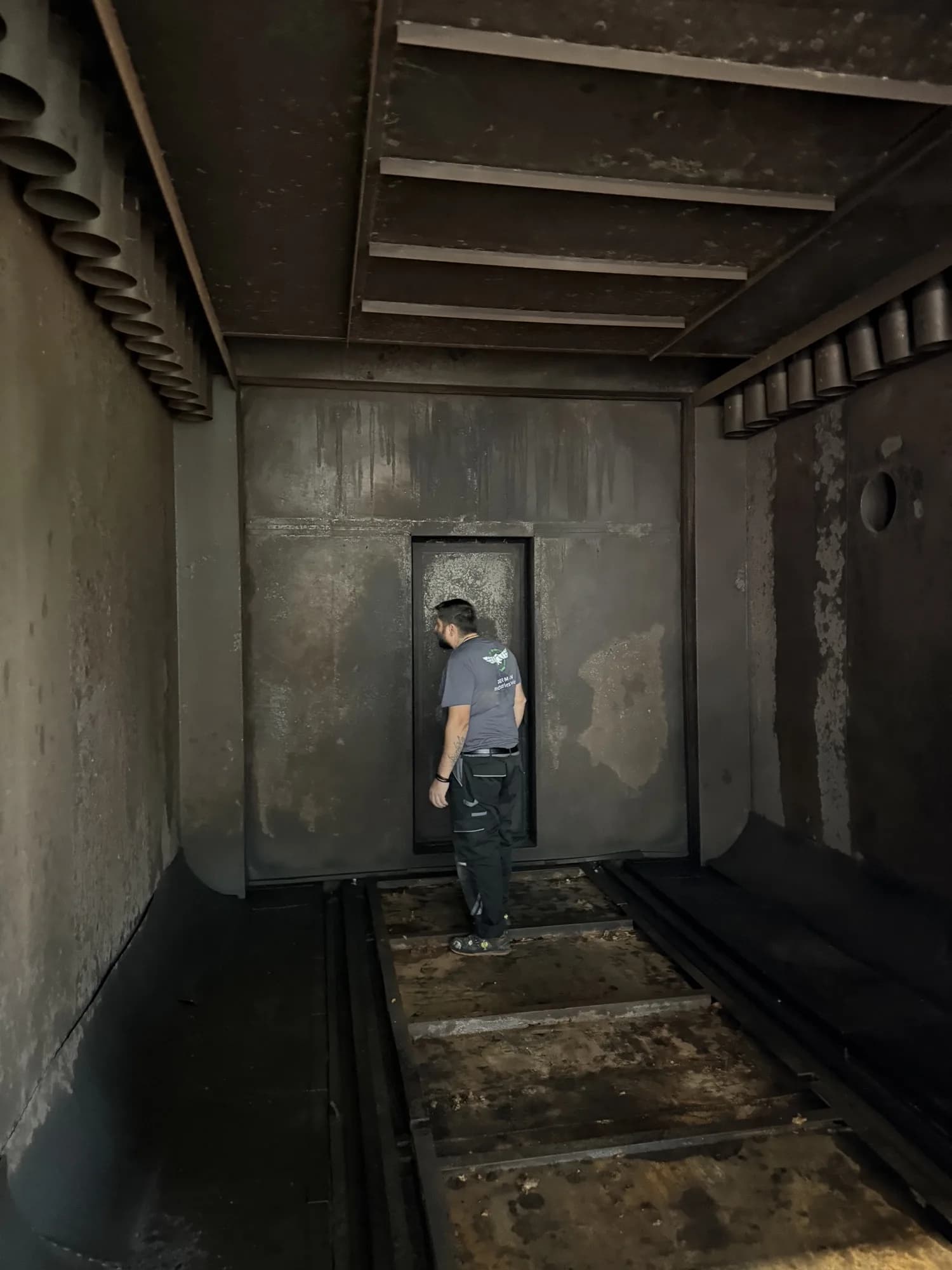
Internal cleaning of tanks requires entry through manholes, special rotating spray heads for CIP or manual high-pressure cleaning. Residual product, biofilm and deposits at weld seams, dead legs and connections are the most common problems.
Conveying systems and pipework
Product residues in long pipe runs can lead to biofilm and contamination. CIP systems are the most efficient solution here; alternatively, pipes must be dismantled and cleaned individually.
Heat exchangers and evaporators
Limescale and protein deposits significantly reduce efficiency. Alternating chemical cleaning with acids (descaling) and alkalis (protein removal) is standard. Frequency: 2–4 times a year, depending on water quality and medium.
Filling plants and portioning machines
Frequent product changes, moving parts, hard-to-reach areas. Here the balance between cleaning depth and downtime is particularly critical; wrong cleaning priorities cause unnecessary production interruptions.
Extruders, mixers, kneaders (food, plastics, pharma)
Baked-on product, lubricant residues and heat exposure make manual cleaning laborious. Dry ice blasting has become established as a gentle method with no blasting media residues and little dismantling effort.
Validating a cleaning method: how a process works under HACCP or GMP requirements
In regulated industries, it is not enough to simply make equipment clean. The method must demonstrably work, and do so reproducibly. Here is the typical validation sequence:
- 1
Risk analysis and definition of limit values
What is the critical residue? In food: allergens, microorganisms. In pharma: active ingredient residues. Limit values are set on the basis of toxicology or food law.
- 2
Developing the standard operating procedure (SOP)
Agents, concentrations, temperatures, contact times, rinse volumes and sequence are laid down in writing. The SOP is the template against which validation is carried out.
- 3
Cleaning runs with sampling
The plant is cleaned according to the SOP. Swab, rinse or wipe samples are then taken from defined critical areas.
- 4
Laboratory analysis and comparison with limit values
The samples are analysed for the residual content of the critical substance (active ingredient, allergen, germ count). If all samples fall below the defined limit value, validation is passed.
- 5
Documentation and release
All results are documented in the validation report. Only after written release may the plant be used for production again.
- 6
Routine revalidation
Changes to the plant, cleaning agent or process require renewed validation. Many businesses also revalidate every 1–3 years even without changes.
CIP systems vs. manual equipment cleaning: which suits your operation?
CIP is not automatically better than manual cleaning, and vice versa. The decision depends on plant type, production volume and budget.
| Criterion | CIP (cleaning in place) | Manual equipment cleaning |
|---|---|---|
| Suitable for | Pipework, tanks, breweries, dairies, pharmaceutical process plants | Machines, filling lines, mixers, extruders, complex geometries |
| Downtime | Very short (1-3 hours depending on the system) | Longer (dismantling may be necessary) |
| Investment costs | High (CIP station, spray heads, controls) | Low (high-pressure equipment, hand tools, chemicals) |
| Documentation | Automatic via control system | Manual, by cleaning staff |
| Dead spaces and dead legs | Problematic; not fully wetted | Re-cleaned manually where needed |
Why external service providers are often the better choice for HACCP/GMP cleaning
Many operations believe that equipment cleaning to HACCP requirements must be carried out by their own staff in order to retain control. The opposite is often true: external cleaning contractors with experience in regulated industries bring documented procedures that are immediately documented and audit-ready. They know the specific requirements of the various certification bodies and have the cleaning chemicals and equipment available for every type of plant.
One key advantage: external service providers can be listed as critical control points in your HACCP concept and issue you with complete documentation for every cleaning job: agents, concentrations, times, temperatures, personnel deployed and, where applicable, sampling results. This makes audits considerably easier.
For companies that have no cleaning department of their own, or whose cleaning staff are not trained for high-risk facilities, outsourcing to a specialised service provider such as Ferman Industrieservice is the recommended solution. For every job you receive written cleaning records from us: every job is documented from A to Z.
Author
Tolga Ferman
Owner, Ferman Industrieservice
Practical knowledge from industrial and building cleaning in Hesse. As of: 2026-08-30.
Conclusion
Equipment cleaning in regulated industries is a discipline of its own, and no job for untrained staff with the wrong equipment. Ferman Industrieservice cleans production plants and industrial facilities across Germany, including multi-day on-site assignments and shutdowns, with large teams for major projects. Every job is documented from A to Z; for special requirements (e.g. explosion-risk areas) we clarify feasibility with the operator in advance. Call us – we are available 24/7 and get back to you in under 2 hours – or request a quote.
Frequently asked questions
Does every food business have to comply with HACCP?+
Yes. Since EU Regulation 852/2004, HACCP has been mandatory for all food processors in the EU, with the exception of primary production. This also covers the cleaning and disinfection of production plant and rooms.
What does cleaning to GMP requirements mean in practice?+
Cleaning to GMP requirements means that the cleaning procedure is described in writing (SOP), validated (proven to be effective) and fully documented. Staff must be trained and the training documented. Every cleaning job is recorded in the batch record or a separate cleaning log.
What is the difference between cleaning and disinfection?+
Cleaning removes visible dirt, product residues and organic matter. Disinfection reduces the germ count to a defined, safe level. For microbiologically critical plant the rule is: clean first, then disinfect. Disinfectants work significantly less well on organically soiled surfaces.
Can dry ice blasting be used for equipment cleaning to HACCP requirements?+
Yes. Dry ice blasting (CO₂ pellets) is suitable for many plant components and has the advantage of leaving no chemical residues. It removes baked-on product residues, fats and oils with less dismantling effort. However, disinfection is still required afterwards, as the process does not kill germs.
How long can a plant stand after cleaning before it has to be disinfected again?+
That depends on the product, the risk profile and the internal SOPs. As a general guideline: for high-risk products (baby food, sterile products), a maximum of 24-48 hours before disinfecting again. Your company's internal HACCP policy is what counts.
Does Ferman Industrieservice provide cleaning documentation for the HACCP concept?+
Yes. For every cleaning job we produce a complete record covering the date, the personnel deployed, cleaning agents and concentrations, methods and contact times, plus an acceptance signature. Wipe or swab samples for your HACCP or GMP concept are usually arranged by the operator through its own laboratory; we coordinate the procedure with you.
How do I find out whether my cleaning contractor works in line with GMP?+
Ask about: existing SOPs for your type of plant, training documentation for the cleaners deployed, references from the pharmaceutical or food industry, and practice in supporting validation. A reputable provider will answer these questions without hesitation.