Key points at a glance
- ✓Definition and delimitation of maintenance cleaning
- ✓Economic benefits of professional cleaning
- ✓Choosing the right cleaning interval
- ✓The detailed scope of services and its limits
- ✓Cost factors and pricing explained transparently
What is maintenance cleaning, exact definition, distinction from deep cleaning and special cleaning
Maintenance cleaning refers to the regularly recurring cleaning of rooms and surfaces according to a fixed schedule. Its main aim is to maintain a hygienic and visually appealing condition in day-to-day use. It typically includes removing loose dirt, dust and light soiling from floors, surfaces, sanitary facilities and office furniture. Intervals are flexible and tailored individually to the intensity of use and the specific requirements of the property, from daily to monthly.
In contrast to maintenance cleaning, deep cleaning is carried out at longer intervals, usually once or twice a year. It removes stubborn soiling, care-product residues and encrusted deposits that have built up over time. This often requires special machines and cleaning agents as well as more intensive treatment of surfaces. Deep cleaning restores the original level of cleanliness, while maintenance cleaning preserves it.
Special cleaning, in turn, consists of one-off jobs that become necessary due to particular incidents or specific requirements. Examples include cleaning after fire damage, water damage, renovation work or large events, or removing graffiti. They cannot be planned in advance and often require specialist know-how and equipment. Maintenance cleaning is thus the foundation of building cleaning and is supplemented by deep cleaning and special cleaning as needed.
Why professional maintenance cleaning pays off, ROI, absenteeism, employee satisfaction, hygiene obligations
Professional maintenance cleaning is not an expense but an investment that pays off for your company in several ways. The benefits go far beyond pure cleanliness and directly affect return on investment (ROI) and operating processes:
Reducing absenteeism and increasing productivity
A hygienically spotless environment minimises the spread of germs and viruses, leading to fewer absences due to illness. Employees feel more comfortable and can concentrate better on their tasks, which significantly boosts efficiency.
Higher employee satisfaction and motivation
Clean, well-kept rooms show employees they are valued. This fosters a positive working atmosphere, boosts motivation and helps you retain skilled staff in the long term.
Meeting hygiene obligations and statutory requirements
Strict hygiene regulations (e.g. HACCP) apply, particularly in production, food and healthcare environments. A professional service provider ensures these standards are met and protects your company from compliance risks.
Preserving the value of property and equipment
Regular, professional cleaning protects floors, furniture and technical equipment from premature wear. This extends the life of your investments and reduces the long-term cost of replacements and extensive refurbishment.
Intervals and frequencies: daily/weekly/fortnightly/monthly, decision matrix
Choosing the right cleaning interval is crucial to the efficiency and cost-effectiveness of your regular maintenance cleaning. A sound decision takes into account how intensively the space is used, the type of premises and the specific hygiene requirements. Here is a comparison of the common intervals:
| Criterion | In-house cleaning | Professional regular maintenance cleaning |
|---|---|---|
| Daily (e.g. offices, washrooms, entrance areas) | High staffing effort, internal coordination, sourcing of materials. Risk of quality shortfalls due to untrained staff. | Consistently high hygiene standard, professional execution, flexible staff planning, optimal use and disposal of materials. |
| Several times a week (e.g. busy offices, staff rooms) | Less flexibility when staff are short, fluctuations in cleaning quality, additional administrative burden. | Ensures a lasting, professional appearance, compliance with specific hygiene requirements and relief for your own employees. |
| Weekly (e.g. less busy offices, meeting rooms) | Risk of visible dirt between cleanings, lack of specialist knowledge for certain surfaces. | Cost-efficient solution for moderately used areas, ensures basic hygiene, trained specialist staff with suitable equipment. |
| Fortnightly (e.g. storage areas, technical rooms with little foot traffic) | Difficulty removing acute soiling, no documentation of cleaning processes. | Economically sensible for areas with light soiling, prevents long-term build-up of dirt, protects materials and infrastructure. |
| Monthly (e.g. archives, rarely used meeting rooms) | Distraction of core staff, no specialisation in cleaning technology, no replacement equipment if devices break down. | Ideal for areas with minimal wear, prevents dust build-up, contributes to long-term value retention, ties up none of your own resources. |
| Decision matrix | Based on the availability of your own employees, often without an in-depth analysis of needs and costs. High risk of absences. | Sound needs analysis by experts, a cleaning plan tailored to your site, transparent cost structure, high planning reliability and quality. |
Scope of services: what is included and what is not (floors, washrooms, offices, canteen, storage)
The scope of regular maintenance cleaning is modular and tailored precisely to each customer's individual needs. Typical services include cleaning floors of all kinds (vacuuming, mopping), hygienic cleaning of sanitary facilities including restocking consumables (soap, toilet paper), cleaning office workstations (desks, monitors, telephones), emptying waste bins and cleaning doors and handles. The aim is to ensure a consistently clean and hygienic environment.
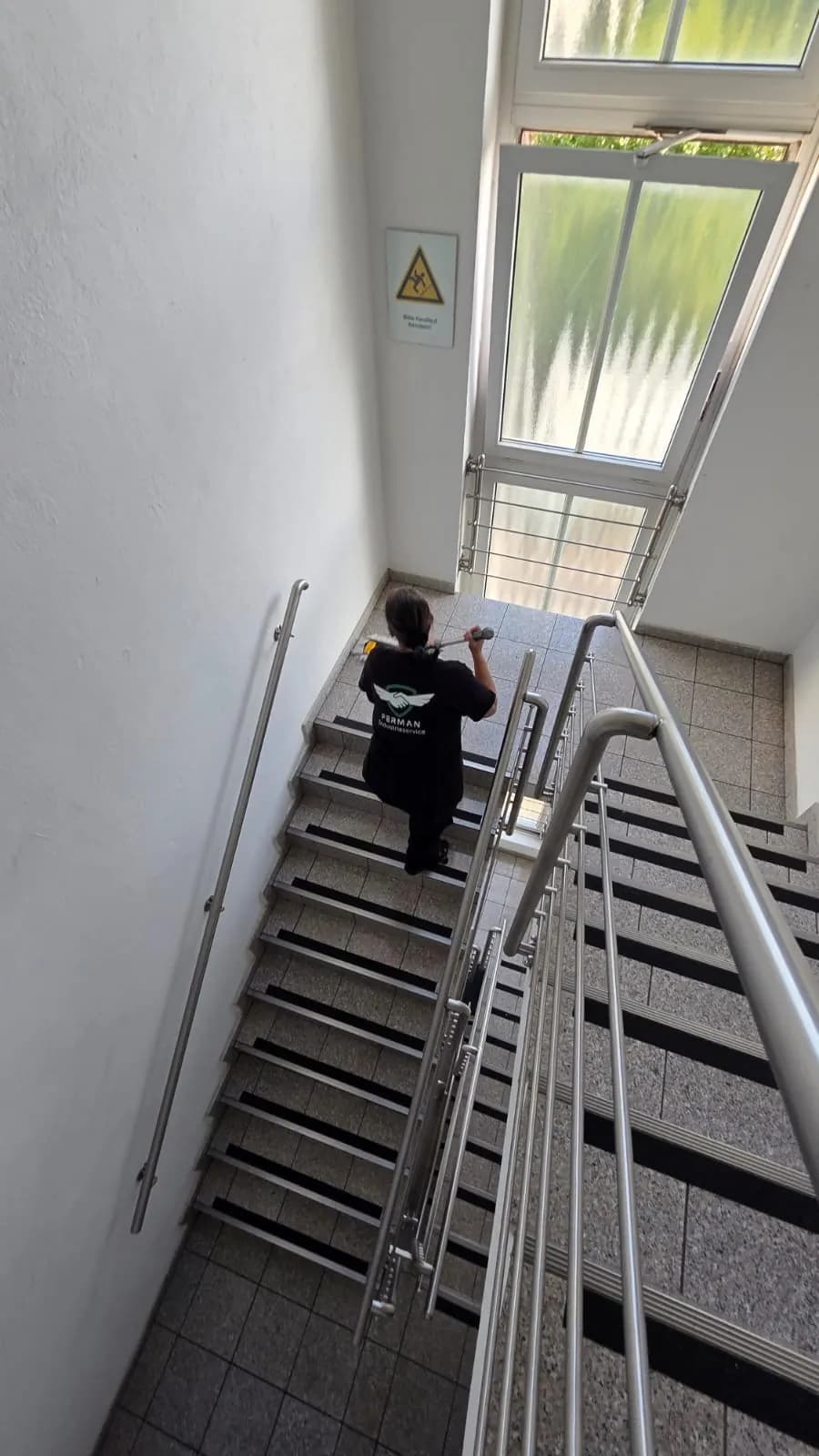
In staff rooms and canteens, regular maintenance cleaning includes cleaning tables and chairs, sinks and work surfaces, as well as floor cleaning. In warehouses and logistics centres, the focus is on removing dust and dirt from floors, shelving and aisles to ensure occupational safety and prevent product contamination. Cleaning entrance areas, stairwells and lifts is also a fixed part of the service, as these areas shape the first impression.
Services that do not normally form part of classic regular maintenance cleaning include window and glass cleaning of windows and facades (except interior glass elements), deep cleaning of floors, carpet cleaning with special extraction methods and the cleaning of machinery and plant in production areas. These services are offered separately as special cleaning and often require specific techniques and safety precautions. A clear demarcation in the service contract is essential to avoid misunderstandings.
In-house cleaning vs. professional service provider: comparing costs, quality, liability and risk of absence
Whether to organise cleaning in-house or award it to an external service provider has far-reaching consequences for your company. A direct comparison helps you weigh up the advantages and disadvantages:
Cost structure and transparency
In-house cleaning: Hidden costs from staff administration, purchasing materials and managing equipment. Professional: Fixed, predictable costs under the service contract, no surprise expenses, precise budget planning possible.
Quality and expertise
In-house cleaning: Often lower cleaning quality due to untrained staff and a lack of specialist equipment. Professional: High, consistent quality from trained specialist staff, use of professional techniques (e.g. microfibre) and equipment.
Liability and insurance
In-house cleaning: Your company bears full liability for damage or accidents, high risk exposure. Professional: The service provider is comprehensively insured (business liability insurance), assumes liability for damage it causes and relieves your company.
Risk of absence and staff management
In-house cleaning: High risk of absence due to sickness or holiday of cleaning staff, complex cover arrangements. Professional: Low risk of absence thanks to a pool of employees, reliable cover, no staff administration for your company.
Focus on core business
In-house cleaning: Ties up valuable resources (time, staff) for non-value-adding tasks. Professional: Relieves internal departments, lets you concentrate on your core business and increases company efficiency.
Regular maintenance cleaning in industry: special requirements, HACCP, hygiene regulations, shift operation
Regular maintenance cleaning in industrial environments places significantly higher demands on the service provider than classic office cleaning. It is not only about cleanliness, but also about complying with complex hygiene and safety standards. In food production in particular, an HACCP concept (Hazard Analysis and Critical Control Points) must be implemented. This requires special cleaning methods, disinfectants and complete documentation of cleaning processes to avoid cross-contamination and ensure product safety.
Another critical point in industry is compliance with occupational health and safety and accident prevention regulations (DGUV, ArbStättV). Cleaning staff must be trained to work with machinery and hazardous substances and to work at height. Continuous shift operation also calls for extremely flexible scheduling. Cleaning work must be organised so that it does not disrupt production, often at night or at weekends, while maintaining the highest safety standards. This requires precise coordination and qualified staff.
Ferman Industrieservice specialises in these particular challenges of industry. We rely on trained staff who are familiar with the specifics of industrial environments. Our processes are HACCP-compatible and we work with digital logs to ensure transparency and traceability. The use of state-of-the-art microfibre technology and environmentally friendly cleaning agents delivers efficient, sustainable results that meet the sector's strict requirements and safeguard the value of your plant.
How we work together: initial site visit, quote, service contract, handover, logs
Successful cooperation starts with transparency and clearly defined steps. Ferman Industrieservice values a structured process that runs from first contact to ongoing quality control and gives you maximum certainty:
- 01
Initial contact and needs analysis
After your enquiry, we carry out a non-binding initial site visit. Together with you, we analyse the specific requirements, the size of the areas, the intensity of use and the cleaning intervals you want. This forms the basis for a concept tailored to your site.
- 02
Individual quote
Based on the needs analysis, we prepare a detailed, transparent quote. It covers all services, the proposed intervals, the materials used and the costs, so you get a clear overview of every item.
- 03
Service contract and staff assignment
Once you accept the quote, we conclude a legally sound service contract. We then select and train the appropriate cleaning staff, who are prepared specifically for the requirements of your site.
- 04
Start of cleaning and handover
Cleaning work begins at the agreed time. A personal handover and briefing on site ensure that all particularities are taken into account. We make sure your operations are not disrupted.
- 05
Ongoing quality control and digital logs
We ensure continuous quality assurance through regular inspections and the use of digital logs. You get access to transparent reports on the work carried out and can give feedback at any time.
Costs and prices, price factors, what regular maintenance cleaning costs per m², when it is more expensive
The cost of professional regular maintenance cleaning depends on various factors and cannot be given as a flat price per square metre. What matters is the size of the area to be cleaned, the type of use (office, production, warehouse), the degree of soiling and the cleaning intervals required. Daily cleaning is naturally more expensive than weekly or fortnightly cleaning. The type of surfaces (e.g. delicate floors, glass fronts) and the special equipment needed also play a part in the price calculation.
We deliberately do not quote a flat price per square metre: two offices of the same size can involve very different amounts of work depending on use, floors and interval, and industrial cleaning with special requirements such as HACCP rules or shift work needs additional planning. That is why we calculate each job individually and list every item in the quote, so you can see exactly what you are paying for. Send us a few photos and the approximate area – you will receive a quote within 24 hours.
Regular maintenance cleaning becomes more expensive when special hygiene regulations (e.g. in hospitals or food businesses), special machines or agents, cleaning outside regular business hours (at night, at weekends) or in hard-to-reach areas are required. Very high frequencies or short-notice changes to the scope of services can also affect the cost. A clearly defined service contract with a detailed specification of services helps avoid unexpected costs and gives you planning certainty.
Checklist: what your cleaning contract should include
General contract components
- ✓Exact names of the contracting parties and contact details.
- ✓Contract term and notice periods.
- ✓Provisions on price adjustments (e.g. with changes in labour costs).
- ✓Agreements on the service provider's liability and insurance.
Scope of services and quality
- ✓Detailed specification of services per room/area (what, how often, with what).
- ✓Fixed cleaning intervals and times.
- ✓Quality assurance measures (e.g. inspection plans, digital logs).
- ✓Cleaning agents and equipment used (environmentally friendly, gentle on materials).
- ✓Arrangements for key handover and access authorisations.
Special requirements and additional services
- ✓Compliance with specific industry standards (e.g. HACCP, DIN standards).
- ✓Arrangements for special cleaning and additional services.
- ✓Contact persons and communication channels for problems or requests.
- ✓Agreements on waste disposal.
- ✓Data protection and staff discretion.
Author
Tolga Ferman
Owner, Ferman Industrieservice
Practical knowledge from industrial and building cleaning in Hesse. As of: 2026-08-30.
Conclusion
The strategic decision for professional regular maintenance cleaning is a key step towards optimising your operations and securing your company's long-term success. Ferman Industrieservice understands the complex requirements of modern industrial and commercial environments in Hesse, Lower Franconia and Rhine-Neckar. With our core promise of meeting deadlines, dedicated contact persons and the flexibility to work at night and at weekends, we offer a suitable solution that meets strict requirements. We know from experience what matters in bringing not only cleanliness but also efficiency and value retention to your company. Contact us today for a non-binding consultation and find out how we can support your company. Visit our regular maintenance cleaning service page or call us directly on +49 176 623 71841.
Frequently asked questions
How are the costs of regular maintenance cleaning calculated?+
Costs are calculated individually based on several factors: the total area, the type of use (office, production, warehouse), the cleaning frequency you want (daily, weekly), the degree of soiling and special requirements such as HACCP rules. After a detailed site visit, we prepare a transparent quote that clearly breaks down all services and cost items. Flat prices per square metre are often misleading, as they do not reflect the complexity of the work.
How often should regular maintenance cleaning be carried out?+
The optimal frequency depends greatly on how intensively the space is used and on the type of premises. Busy areas such as sanitary facilities, entrance areas or production halls often require daily cleaning. Less busy offices can also be cleaned several times a week or weekly. In less critical areas such as archives, a fortnightly or monthly interval may be enough. A precise needs analysis on site helps us define the most economical and effective interval for you.
Do I need to prepare my company for cleaning?+
Good preparation makes the cleaning team's work easier and ensures optimal results. This includes tidying desks and putting personal items away so that all surfaces are freely accessible. In production areas, routes should be kept clear and hazardous areas marked. We discuss all necessary preparations during the initial site visit and, where appropriate, draw up a detailed plan to ensure things run smoothly and your operations are not disrupted.
Which cleaning techniques and methods are used?+
Ferman Industrieservice relies on state-of-the-art, environmentally friendly cleaning techniques. These include microfibre technology, which enables effective cleaning with minimal use of chemicals. For floors, depending on the surface and degree of soiling, we use dry vacuums, scrubber-dryers or mopping systems. In sensitive areas we use special disinfectant cleaners. Our methods are designed to meet strict hygiene standards, be gentle on materials and minimise environmental impact.
Which certifications and standards does Ferman Industrieservice meet?+
As a professional provider of industrial cleaning, Ferman Industrieservice attaches great importance to complying with relevant standards. For customers in the food industry, we align our procedures with the site's hygiene requirements, for example its HACCP concept. We comply with statutory occupational health and safety and accident prevention regulations (DGUV, ArbStättV), and our staff receive regular instruction. We provide evidence on request.
How is the quality of the cleaning service ensured?+
Quality assurance is a central part of our work. We implement detailed cleaning plans and work instructions for every site. Our team leaders carry out regular quality inspections, the results of which are recorded in digital logs. These logs give you maximum transparency and allow complete traceability of the services provided. We also stay in close contact with our customers so that we can take on feedback immediately and make adjustments where needed. Your satisfaction is our benchmark.
What is the difference between regular maintenance cleaning and deep cleaning?+
Regular maintenance cleaning is the recurring cleaning that keeps everyday surfaces in a clean condition, for example mopping floors or cleaning sanitary facilities. Deep cleaning, by contrast, is an intensive, less frequent clean (e.g. annually) that removes stubborn soiling, coatings and care-product residues to restore the original level of cleanliness. It is considerably more labour-intensive and often requires special machines and chemicals, whereas regular maintenance cleaning removes the dirt that accumulates day to day.