Key points at a glance
- ✓Preserving precision and extending machine service life
- ✓Minimising production outages and repair costs
- ✓Compliance with strict hygiene and quality standards (HACCP, GMP)
- ✓Improving occupational safety and employee satisfaction
- ✓Sustainable operations through efficient cleaning methods
What is machine cleaning? Definition, and why cleanliness extends machine service life
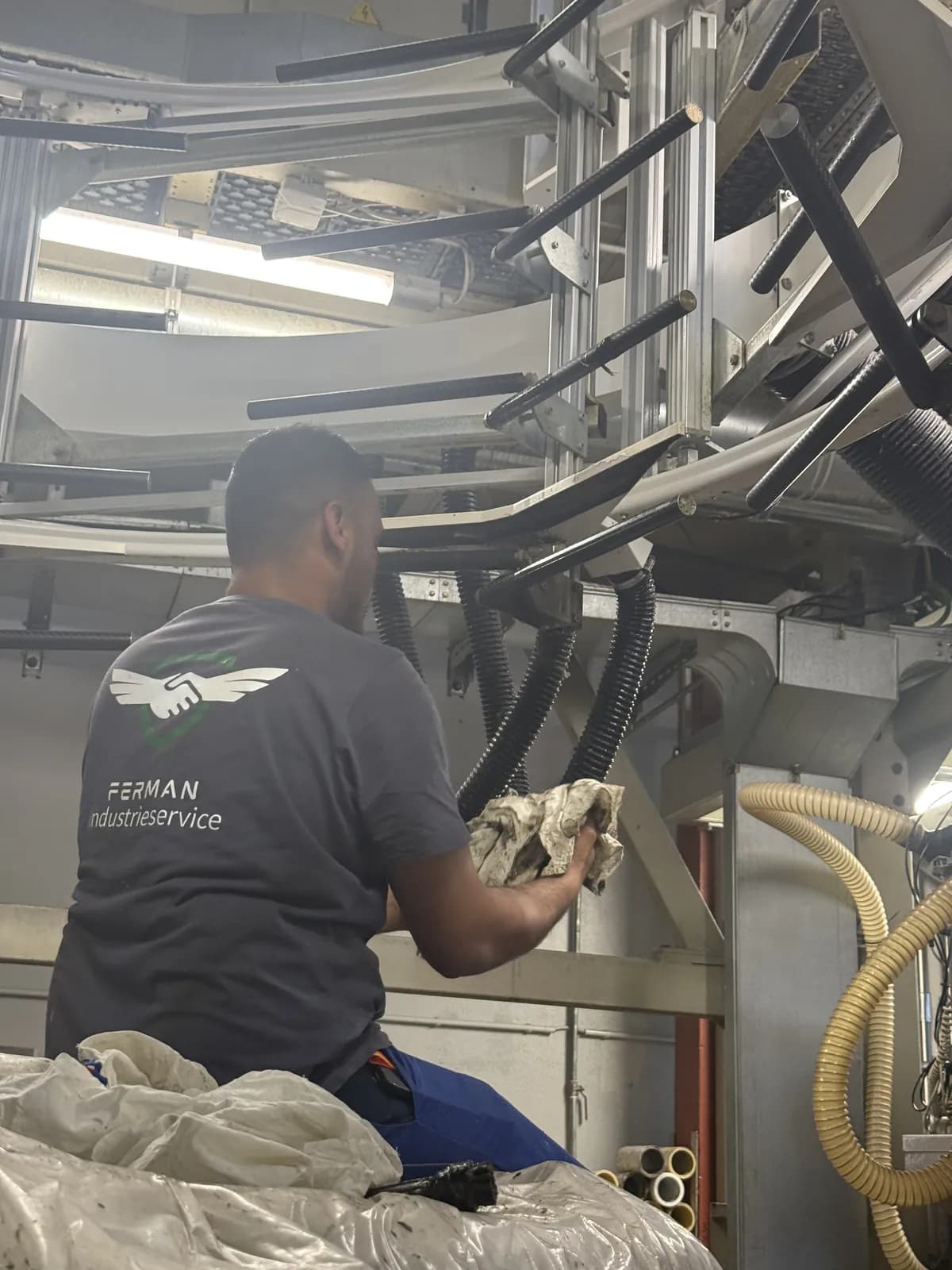
Machine cleaning is the systematic removal of contaminants such as swarf, oils, greases, dust, coolants, residues and other production by-products from industrial plant, production lines, presses and especially sensitive CNC machines. In contrast to superficial cleaning, professional machine cleaning aims to thoroughly clean hard-to-reach areas, internal components and functional parts too, without the plant having to be dismantled. This requires specialised techniques and trained personnel to safeguard the integrity of the machines while achieving the highest level of cleanliness.
The importance of cleanliness for machine service life can hardly be overstated. Deposits act like an insulating layer, which can cause motors and electronics to overheat. Particles in moving parts increase wear and accelerate material fatigue. Corrosive substances, often contained in coolants or residues, attack metal surfaces and weaken the structure. Regular, professional cleaning protects against these harmful influences by preserving the functionality of components and thus significantly extending the service life of your investments. This leads to more stable and reliable production.
Moreover, a clean machine contributes significantly to maintaining its original precision. Fine particles or resinified residues can impair the accuracy of axes, sensors and tools, leading to quality losses in the end products. By eliminating these disruptive factors, process stability is secured and the need for costly rework or scrap is reduced. A well-maintained machine is therefore not only more durable, but also more economical to run, as it consistently delivers high quality standards and minimises unplanned downtime.
Consequences of dirty machines: loss of precision, error patterns, HACCP violations, loss of warranty
Dirty machines are a ticking time bomb for every industrial company. The consequences go far beyond unsightly appearance and can have serious economic, quality-related and legal effects:
Loss of precision and quality defects
Deposits of swarf, oils or dust can interfere with the fine mechanics and sensors of CNC machines. This leads to inaccurate machining results, increased tolerances and therefore scrap or costly rework, which severely impairs product quality.
More faults and unplanned downtime
Dirt can impede heat dissipation, cause motors to overheat and damage electronic components. This shows up in more frequent machine failures, error messages and unplanned production stops, which lead to considerable delivery delays and loss of revenue.
Risk of HACCP violations in food production
In sensitive industries such as food production, contaminants such as bacteria, allergens or foreign bodies in machines can cause product contamination. This can lead to serious HACCP violations, product recalls, reputational damage and heavy fines.
Loss of warranty claims and higher repair costs
Many machine manufacturers make warranty claims conditional on compliance with prescribed maintenance and cleaning intervals. Inadequate care can cause the warranty to lapse. In addition, premature wear caused by dirt increases the need for expensive repairs and spare parts procurement.
Comparison of cleaning methods: dry ice vs. high pressure vs. steam vs. chemical
Choosing the right cleaning method is crucial to the success of machine cleaning. Each method has specific advantages and disadvantages that must be weighed up depending on machine type, degree of soiling and material properties. Ferman Industrieservice offers a wide range of methods to find the optimal solution for every challenge. Here is a comparison of the most common methods:
| Criterion | Dry ice blasting | High-pressure cleaning |
|---|---|---|
| Principle | Use of solid CO2 (-78.5 °C), which sublimates on impact and loosens the dirt through thermal shock and kinetic energy. | Water or aqueous solutions are sprayed onto the surface at high pressure (several hundred bar depending on the method) to remove dirt mechanically. |
| Suitability | Ideal for sensitive electronics, electrical systems, production equipment with fine mechanics, moulds, casting tools. Can also be used in the food industry. | Good for robust surfaces, large machine components, concrete floors, stubborn oil and grease residues. Caution with sensitive components and electronics. |
| Residues | No secondary waste, because dry ice sublimates into gas. Only the removed dirt has to be disposed of; afterwards the surfaces are thoroughly clean and dry. | Produces wastewater that must be collected and disposed of properly, especially with oil or chemical contamination. Drying time required. |
| Surface protection | Very gentle on surfaces and non-abrasive. No damage to cables, seals or sensitive surfaces. No corrosion. | If used improperly or at too high a pressure, it can damage surfaces, cause paint to flake or penetrate sensitive bearings. Risk of corrosion from water. |
| Environmental aspects | Environmentally friendly, as no chemical additives are used. CO2 is obtained from industrial processes and not additionally produced. | Use of cleaning agents may be necessary. High water consumption. Wastewater treatment is often complex and energy-intensive. |
| Application | Often possible during ongoing operation, as it is dry and non-conductive. No dismantling necessary. Fast and efficient. | Machines generally have to be switched off and protected from moisture. Longer drying times can interrupt the production flow. |
Machine cleaning during ongoing operation, planning into maintenance windows, night shifts, no production outage
For many manufacturers, the biggest challenge is carrying out cleaning work without interrupting production processes. Ferman Industrieservice has specialised in meeting exactly this challenge. By using modern methods such as dry ice blasting, it is often possible to clean machines even during ongoing operation or short downtimes. This significantly reduces production outages and allows our customers to maintain their efficiency without compromising on cleanliness. Precise planning and coordination are of the utmost importance here to ensure a smooth process.
Our experienced teams work closely with your plant managers and production managers to integrate cleaning plans optimally into your maintenance windows. Whether planned shutdowns, short breaks between shifts or weekend maintenance, we find the right time. Jobs on night shifts or at weekends prove particularly efficient. That way, your machines can be cleaned and put straight back into operation on the next working day, without losing valuable production time. This approach is a core promise of Ferman Industrieservice: punctuality and flexible hours for your business.
With this strategic approach, we make sure that machine cleaning does not become a bottleneck but an integral part of your efficient production planning. Our aim is to deliver thorough cleanliness that maximises the performance of your plant, without you having to fear a single production outage. This applies in particular to sensitive plant such as CNC machines, presses and complex production lines that must consistently deliver the highest precision. We know from practice what matters in keeping your machines in top shape while securing your supply chains.
Industry-specific requirements: automotive (coolant, swarf), food (HACCP, allergens), pharma (GMP), CNC
Every industry has its own challenges and regulatory requirements that must be taken into account in machine cleaning. Ferman Industrieservice has comprehensive know-how across various branches of industry:
Automotive and metal industry
Stubborn residues of coolants and lubricants, oils, greases and metal swarf dominate here. Cleaning has to be effective to preserve precision and minimise fire hazards, without damaging sensitive surfaces or electronics. Thorough removal is essential for the quality assurance of the components.
Food Production
Strict hygiene standards are necessary in this industry. Cleaning must follow the client's site-specific hygiene requirements to prevent cross-contamination with allergens, bacteria or foreign bodies. Methods without chemical residues are often used to ensure food safety and stand up to audits.
Pharmaceutical industry
The strict GMP guidelines (Good Manufacturing Practice) apply here. Machine cleaning must be validatable and completely remove traces of active ingredients and microorganisms to safeguard product purity and patient safety. Documentation and process reliability are of the highest importance.
CNC manufacturing
CNC machines are the heart of many manufacturing operations. Cleaning must protect precision parts, tool changers and controls. Coolant sludge, swarf and resin deposits must be removed to maintain accuracy, reduce tool wear and maximise machine service life.
General mechanical engineering and manufacturing
Regardless of specific niches, general mechanical engineering requires cleaning that ensures the functionality of presses, production lines and assembly systems. The aim is to ensure operational readiness, minimise wear and support compliance with DGUV occupational safety regulations.
Step by step: how professional machine cleaning works
Professional machine cleaning is a carefully planned and precisely executed process that goes far beyond simple cleaning. At Ferman Industrieservice, every order begins with a detailed needs analysis and site inspection. Here we record the machine type, degree of soiling, material properties and specific requirements such as production windows or hygiene regulations. Based on this information, we develop a cleaning concept tailored to your site that defines the optimal method (e.g. dry ice, high pressure, steam) and the schedule. This planning phase is crucial to the success and efficiency of the subsequent execution.
Once the plan is agreed, the work area is prepared. Where necessary, this includes securing sensitive areas, covering components that are not to be cleaned and setting up the logistics for the cleaning equipment and the later disposal of dirt. Our experienced, safety-briefed teams with fixed contact persons then carry out the cleaning according to the agreed plan. They work with great care and precision to clean every machine thoroughly and gently, with as little dismantling as possible. Compliance with all safety regulations (DGUV) goes without saying.
The conclusion of the cleaning includes a thorough quality check, in which we verify the cleanliness and functionality of the cleaned machines. Any dirt and residues arising are collected and disposed of properly. Finally, the work carried out is documented in detail. Our aim is not only to hand over a clean machine, but also the assurance that your plant can once again run at maximum performance and precision. This systematic approach secures you efficient, safe and high-quality machine cleaning that meets and exceeds your expectations.
Cleaning intervals for machines, by operating hours, by degree of soiling, regulatory
Determining the optimal cleaning intervals is crucial to preserving the value and efficiency of your machines. Various factors have to be considered to strike a balance between cost and benefit. Ferman Industrieservice is happy to advise you on drawing up an individual cleaning plan:
- 01
Operating hours and utilisation
A commonly used criterion is the number of operating hours. Heavily used machines, especially CNC systems, accumulate dirt faster and therefore need shorter cleaning intervals, for example every 200-500 operating hours, to ensure precision and function.
- 02
Degree of soiling and type of production
The type of parts produced and the materials used has a considerable influence on the degree of soiling. Machining cast iron or steel with a lot of coolant produces more residues than machining plastics. A visual inspection can indicate the actual need.
- 03
Regulatory and industry-specific requirements
In industries such as food or pharmaceuticals, cleaning intervals are often prescribed by HACCP, GMP or other DIN standards and internal quality management systems. These must be strictly observed to ensure compliance and product safety and to pass audits.
- 04
Manufacturer recommendations and warranty terms
Machine manufacturers often state specific cleaning intervals in their maintenance manuals. Following these recommendations is vital not only for optimal function but also for retaining warranty claims, and should not be neglected.
- 05
Individual experience and monitoring
Over time, companies develop their own experience of which intervals are optimal for which machine. Continuous monitoring of machine performance, scrap and maintenance frequency helps to adjust and optimise cleaning intervals dynamically.
Cost of machine cleaning, price factors, what does CNC cleaning cost, ROI calculation
The cost of professional machine cleaning is not a flat figure but is made up of various factors. The main price factors include the machine type and its complexity (e.g. a simple press vs. a complex 5-axis CNC machine), the degree and type of soiling (light layer of dust vs. resinified coolant residues), the cleaning method chosen (dry ice is often more efficient, but the material costs more than water) and the time and personnel required. Accessibility of the machine and the need for special jobs (night/weekend) also affect the price. An accurate cost calculation therefore always requires an individual on-site assessment.
What does CNC cleaning cost, for example? A flat figure is hard to give because it varies widely. The cost depends mainly on machine size, degree of contamination, accessibility, method and time window; you will receive a quote within 24 hours. Ferman Industrieservice values transparent quotes that clearly itemise every service. After a no-obligation visit to your site we give you a detailed assessment, so you have a precise basis for your budget planning. We carry out machine cleaning throughout Hesse and across Germany – quickly and flexibly.
Do not regard the cost of machine cleaning as an expense, but as an investment with a clear return on investment (ROI). Regular cleaning extends the service life of your machines, reduces unplanned downtime and significantly lowers repair costs. It also improves product quality and energy efficiency. If you set these savings and productivity gains against the cleaning costs, the positive ROI quickly becomes apparent. A well-maintained machine secures your competitiveness and recoups the cleaning costs many times over through higher availability and better production results. Get in touch, we will gladly help you calculate your individual ROI.
Checklist: preparing for and following up a machine cleaning
Preparation by the customer
- ✓Take the machine out of operation and secure it against restarting (check LOTO procedure).
- ✓Ensure access to the areas to be cleaned (e.g. open protective doors).
- ✓If applicable, remove tools, clamping devices and workpieces from the work area.
- ✓Provide information on special features, sensitive components or material compatibility.
- ✓Provide power connections (electricity, compressed air if applicable) and lighting at the cleaning location.
Preparation by the service provider (Ferman)
- ✓Detailed machine audit and agreement on the cleaning method.
- ✓Covering and protecting sensitive components (e.g. controls, displays, sensors).
- ✓Setting up the work area and cordoning off the cleaning zone.
- ✓Providing the specialised cleaning equipment and materials (e.g. dry ice blasting unit).
- ✓Ensuring compliance with all occupational safety regulations (DGUV).
Follow-up by the service provider and customer
- ✓Thorough quality check of the cleaned machine.
- ✓Proper disposal of all dirt and residues arising.
- ✓Removing protective equipment and tidying the work area.
- ✓Documentation of the cleaning work carried out.
- ✓Functional check of the machine by the customer before recommissioning.
Author
Tolga Ferman
Owner, Ferman Industrieservice
Practical knowledge from industrial and building cleaning in Hesse. As of: 2026-08-30.
Conclusion
Die professionelle Maschinenreinigung ist weit mehr als nur eine kosmetische Maßnahme; sie ist eine strategische Investition in die Zukunft Ihres Unternehmens. Sie sichert nicht nur die Präzision und Langlebigkeit Ihrer Anlagen, sondern minimiert auch unerwartete Stillstände, senkt Reparaturkosten und gewährleistet die Einhaltung kritischer Branchenstandards. In einer Zeit, in der Effizienz und Qualität entscheidend sind, kann die Vernachlässigung der Maschinenhygiene teure Konsequenzen haben. Ferman Industrieservice reinigt Ihre Maschinen deutschlandweit – mit Trockeneis, Dampf und Hochdruck, auch nachts, am Wochenende und an Feiertagen, bei Bedarf mit großen Teams und mehrtägig vor Ort. Jeder Einsatz wird von A bis Z professionell dokumentiert. Rufen Sie uns 24/7 an – Rückmeldung in unter 2 Stunden – oder fordern Sie Ihr Festpreis-Angebot nach Begehung an: Maschinenreinigung von Ferman: Angebot in 24 Std. anfordern.
Frequently asked questions
How often should machine cleaning be carried out and which factors influence the interval?+
The frequency of machine cleaning depends heavily on the industry, the machine type and utilisation. CNC machines in metal processing often need cleaning every 200-500 operating hours, while plant in food production must be cleaned weekly or even daily to meet HACCP standards. Factors such as the degree of soiling, the type of materials processed, manufacturer recommendations and legal requirements (e.g. GMP in pharma) play a decisive role. An individual assessment by Ferman Industrieservice helps you draw up the optimal cleaning plan, taking efficiency and costs equally into account.
What costs are involved in professional machine cleaning and how is the price calculated?+
The cost of professional machine cleaning varies depending on the complexity of the machine, the degree and type of soiling, the cleaning method chosen (e.g. dry ice blasting is more material-intensive) and the time and personnel required. A flat figure is therefore difficult. After a non-binding site inspection, Ferman Industrieservice prepares a transparent and detailed quotation that takes all factors into account. The aim is to offer you a cost-efficient solution that preserves the value of your machines and lowers operating costs in the long term. Invest in cleanliness to avoid costly breakdowns.
Can machine cleaning take place during operation or outside regular working hours?+
Yes, Ferman Industrieservice specialises in carrying out machine cleaning flexibly and with minimal disruption to production. Thanks to methods such as dry ice blasting, it is often possible to clean machines even during ongoing operation or short maintenance windows. For more extensive cleaning, we offer jobs on night shifts or at weekends to avoid production outages. Our core promise is punctuality and flexible hours. We plan the cleaning closely with you so as not to disrupt your operations and to get your machines ready for use again on time, with one contact person for the whole job.
Which cleaning methods does Ferman Industrieservice offer and when is each used?+
Ferman Industrieservice offers a broad range of state-of-the-art cleaning methods, including dry ice blasting, high-pressure cleaning, steam cleaning and industrial vacuuming. Dry ice blasting is ideal for sensitive electronics and machines, as it cleans thoroughly and is non-abrasive. High-pressure cleaning is suited to robust surfaces and stubborn soiling, while steam cleaning is an effective, hygienic option without chemicals. The choice of method depends on machine type, type of soiling and material sensitivity. We advise you comprehensively to find the optimal, material-friendly and most efficient method for your specific requirements.
Which certifications or quality standards does Ferman Industrieservice meet in machine cleaning?+
As a professional industrial service provider, Ferman Industrieservice places the greatest value on quality and compliance with relevant standards. In food and pharmaceutical plants, we align the cleaning with the client's hygiene requirements, for example its HACCP concept. We comply with the DGUV occupational safety regulations, document every job from A to Z and deploy experienced, briefed teams. We do not hold company certificates of our own; evidence on briefings and processes is available on request.
What is the difference between machine cleaning and machine maintenance or servicing?+
Machine cleaning is a part of machine care that focuses on removing dirt, deposits and residues in order to preserve functionality and precision. Maintenance, by contrast, comprises preventive measures such as inspections, lubrication and replacement of wear parts to avoid failures. Asset maintenance (Instandhaltung) is the overarching term covering all measures to preserve and restore the target condition of a plant, including cleaning, maintenance and repair. Professional cleaning is the basis for effective maintenance and reduces the need for costly repairs by preventing problems early and extending the service life of your machines.
What are the advantages of hiring an external service provider like Ferman Industrieservice over in-house cleaning?+
Die Beauftragung von Ferman Industrieservice bietet Ihnen zahlreiche Vorteile. Sie profitieren von spezialisierter Erfahrung, modernen Verfahren wie Trockeneis, die intern oft nicht verfügbar sind, und einem Einsatzteam, das die Arbeit effizient und sicher ausführt. Das spart Ihnen Investitionen in teure Ausrüstung und Schulungen. Wir sind 24/7 erreichbar, auch nachts, am Wochenende und an Feiertagen, ohne dass Sie sich um Personalplanung oder Koordination kümmern müssen. Unsere gründliche Reinigung mit wenig Demontageaufwand minimiert Produktionsausfälle. Konzentrieren Sie sich auf Ihr Kerngeschäft, während wir Ihre Maschinen pflegen – deutschlandweit, bei Bedarf auch mehrtägig vor Ort.