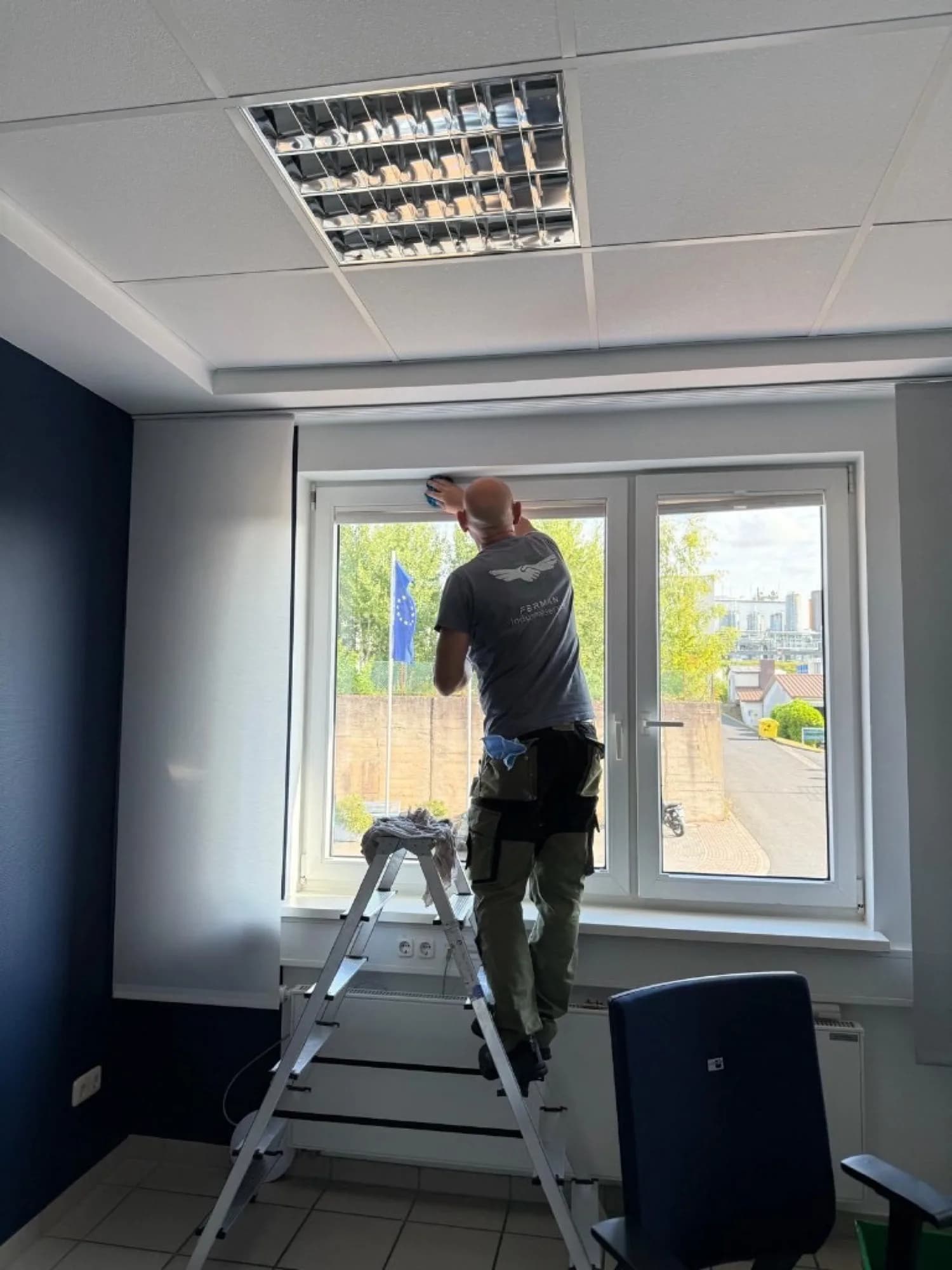
Key points at a glance
- ✓A comprehensive definition of commercial building cleaning and how it differs from other forms
- ✓Statutory obligations for hygiene and occupational safety for employers
- ✓A detailed introduction to the different types of cleaning and services
- ✓The importance of a holistic approach for efficiency and quality
- ✓Practical advice on choosing and switching cleaning providers
What is commercial building cleaning: how it differs from domestic cleaning, and scope of services
Commercial building cleaning covers the systematic care and upkeep of commercially used properties. In contrast to domestic cleaning, which is often tailored to individual needs and follows less strict guidelines, B2B building cleaning operates to fixed standards, schedules and statutory requirements. It takes into account the specific requirements of different sectors, such as offices, production sites or healthcare facilities, and requires specialised staff as well as professional equipment and cleaning agents in order to ensure maximum hygiene and preservation of value.
The scope of services goes far beyond mere sweeping and mopping. It includes detailed cleaning plans for specific areas such as offices, administration buildings, stairwells, sanitary facilities and entrance areas. The care of sensitive surfaces, disinfection in critical zones and regular window, glass and façade cleaning are also part of it. A professional provider such as Ferman Industrieservice offers a comprehensive service that covers all building care and so ensures consistently high standards of cleanliness and hygiene, which is essential for operations.
Another key difference lies in documentation and quality assurance. Commercial cleaning providers work with checklists, protocols and regular inspections to ensure that the agreed standards are met. They are also familiar with the relevant occupational safety and hygiene regulations, which is of great importance for companies in avoiding legal consequences. Working with an external specialist relieves internal resources and ensures efficient and professional execution of the cleaning tasks, always taking into account the individual requirements of the property.
Employer obligations for building hygiene: ArbStättV, ASR A4.1, HACCP, liability
Employers bear a major responsibility for hygiene and safety in the workplace. Compliance with statutory regulations is not only a matter of duty of care but also a legal necessity, in order to protect employees and minimise liability risks. Here are the most important sets of rules you should know about:
Workplace Ordinance (ArbStättV)
The ArbStättV lays down minimum requirements for the safety and health protection of employees when setting up and operating workplaces. This also includes provisions on regular cleaning and maintenance to ensure a hygienic environment.
Technical Rules for Workplaces (ASR A4.1, sanitary facilities)
This ASR specifies the requirements of the ArbStättV with regard to sanitary facilities. It defines in detail the equipment, cleanliness and maintenance of toilets, washrooms and changing rooms, in order to minimise infection risks and ensure employee comfort.
HACCP concept (Hazard Analysis and Critical Control Points)
The HACCP concept is essential, in particular in food-processing businesses. It serves to identify, assess and control hazards that could compromise food safety. Professional cleaning is a critical control point here for preventing contamination.
Employer liability
If hygiene regulations are not complied with, employers face not only fines but also civil liability claims should employees fall ill due to a lack of cleanliness or suffer accidents at work caused by slip hazards. Professional building cleaning effectively minimises these risks.
Types of building cleaning service: regular maintenance cleaning, deep cleaning, window and glass cleaning, special cleaning
Choosing the right cleaning model is crucial for efficiency and cost control. A single-service contract offers flexibility for specific needs, while a full building service is a comprehensive one-stop solution that reduces planning effort and creates synergies. Compare the advantages:
| Criterion | Single-service cleaning contract | Full building service |
|---|---|---|
| Scope | Focused on one specific type of cleaning (e.g. regular maintenance cleaning only). | Comprehensive coverage of all cleaning needs of the entire property. |
| Coordination | Several providers needed for different cleaning tasks. | One central contact for all cleaning services, simplified communication. |
| Cost structure | Separate invoicing per service, potentially higher total costs due to overhead. | Often a flat-rate invoice, transparent costs, potential for economies of scale. |
| Flexibility | High flexibility in commissioning individual services as needed. | Less ad-hoc flexibility, but proactive planning and management of all services. |
| Quality | Quality may vary depending on the individual provider; coordination effort. | Consistently high quality thanks to uniform standards and trained staff of the full-service provider. |
| Depth of service | Limited to the agreed individual service, less strategic advice. | Strategic advice, proactive maintenance, one partner for all hygiene questions. |
Building cleaning for different types of property: office building, industrial site, administration, educational institution
The requirements for building cleaning vary considerably depending on the type and use of the property. A modern office building needs daily maintenance cleaning that creates a pleasant working atmosphere, whereas an industrial site with production halls requires special cleaning methods for machines and floors and for removing production residues. Special cleaning agents, high-pressure cleaners or industrial vacuum cleaners are often necessary here to remove stubborn soiling such as oils, greases or dusts effectively and to ensure occupational safety.
Administration buildings, often prestigious and open to the public, place great value on clean, well-kept entrance areas, clean sanitary facilities and tidy offices in order to leave a professional impression. Cleaning intervals here are typically tightly scheduled. Educational institutions such as schools or universities, by contrast, require building cleaning that puts an emphasis not only on cleanliness but also on hygiene, in order to minimise the spread of germs. Disinfection measures in sanitary areas and classrooms, as well as flexible adaptation to holiday periods and events, are often required here.
An experienced provider such as Ferman Industrieservice understands these differing needs and develops cleaning concepts tailored to your business. Whether it is a matter of meeting strict HACCP standards in the food industry, caring for sensitive IT rooms in an administration building or cleaning quickly and discreetly in a busy office, the use of trained staff, specific equipment and ecological cleaning agents is crucial. Only in this way can optimum cleanliness, functionality and preservation of value be ensured for each individual property, regardless of its use and specific challenges.
Sustainability in building cleaning: ecological agents, water consumption, energy efficiency, certificates
Sustainability is not a trend but a necessity. Companies can make a considerable contribution in building cleaning too. A responsible provider integrates ecological principles into all work steps, from the choice of materials to the use of resources. This protects not only the environment but also the health of your employees and the fabric of your building.
Ecological cleaning agents
The use of environmentally friendly, biodegradable cleaning agents considerably reduces the load on wastewater and indoor air. These products are free of aggressive chemicals, are gentle on surfaces and are safer for the health of staff and building users.
Optimised water consumption
Modern cleaning technologies such as microfibre or special dosing systems allow a significant reduction in water consumption. Using rainwater or treated greywater for certain cleaning tasks can also help conserve resources.
Energy-efficient equipment
Using energy-efficient cleaning machines with high energy efficiency ratings reduces electricity consumption. Investments in modern, high-performance equipment pay off in the long term through lower operating costs and a smaller ecological footprint.
Waste management and recycling
Well-thought-out waste management that promotes the separation and recycling of packaging, cleaning cloths and other consumables minimises the volume of waste. This contributes to the circular economy and reduces landfilling of waste.
Certificates and standards
Ask which cleaning agents are used, how water and waste are handled and whether safety data sheets are available. A good provider can answer this specifically and present evidence on request.
One provider for all areas: why a full-service provider is superior to several providers
Engaging several providers for different cleaning tasks may seem flexible at first glance, but in practice it often leads to increased management effort, coordination problems and potential quality gaps. Each individual provider has to be briefed, monitored and invoiced separately. This ties up valuable internal resources, particularly among purchasing managers and facility managers, who could use their time more efficiently for more strategic tasks. Coordinating schedules and interfaces becomes complex, which can lead to delays or duplicated work.
A full-service provider such as Ferman Industrieservice, by contrast, offers the decisive advantage of a single point of contact for all cleaning services. From office cleaning and industrial cleaning to window, glass and special cleaning, everything is coordinated from a single source. This simplifies communication considerably, minimises administrative effort and ensures consistently high service quality. There is no confusion over responsibilities or standards, and any problems can be solved quickly and efficiently, as the provider bears overall responsibility for the property.
In addition, a full-service provider often enables synergies and economies of scale. By bundling services, processes can be optimised, staff deployed more flexibly and purchasing advantages realised on materials and equipment, which can have a positive effect on costs. Uniform quality management and trained staff who are familiar with all areas of the property also ensure consistent cleanliness and upkeep, which secures the value of your property in the long term and ensures an always professional appearance. This relieves your team and builds trust.
Quality assurance in building cleaning: inspections, checklists, complaints management
Quality is no coincidence but the result of systematic processes. A professional building cleaning provider implements comprehensive quality assurance measures to ensure that agreed standards are met and to maximise customer satisfaction. This process is essential for a successful long-term partnership:
- 01
Defining the specification of services
At the outset, detailed specifications of services (LV) are drawn up that define exactly which areas are cleaned, how often and with which methods. This LV serves as the binding basis for all cleaning work and for later quality control.
- 02
Regular property inspections
Dedicated contacts at the provider carry out inspections of the cleaned properties at agreed intervals. All areas are checked systematically to ensure that quality standards are met in accordance with the LV and to identify potential for improvement.
- 03
Use of quality checklists
Detailed checklists are used for every inspection and for the cleaning staff themselves. These standardised documents ensure that all relevant aspects of cleaning are checked and assessed systematically, from cleanliness to the completeness of the work.
- 04
Efficient complaints management
Despite all due care, defects can occur. A professional provider has a clear complaints management process that ensures defects are reported, handled and rectified quickly within defined deadlines. Direct contact is crucial here.
- 05
Continuous communication and optimisation
Regular feedback meetings with the customer are necessary. The results of inspections and complaints are discussed in order to improve processes continuously, adjust cleaning plans and keep service quality consistently high in the long term.
Costs and specification of services: how building cleaning is tendered and awarded
The tendering and awarding of building cleaning services is a structured process that ensures transparency and a fair selection of the right provider. First, a detailed specification of services (LV) is drawn up. This document describes precisely all the services to be provided, including types of cleaning (e.g. regular maintenance, deep, window and glass cleaning), cleaning intervals, areas to be cleaned in square metres, materials and equipment used, and specific hygiene regulations or safety requirements. A well-prepared LV is the basis for comparable quotes and minimises later misunderstandings.
Based on the specification of services, companies request quotes from qualified cleaning providers. It is important here to compare not only the price but also the quality of the services offered, references, certifications, the experience of the staff and traceable documentation of the services. A transparent cost breakdown that sets out staff costs, material costs, equipment use and overhead in detail allows a well-founded comparison. Many providers calculate by square metre, cleaning interval or hourly rate, depending on the property and the specific requirements.
After the quotes have been reviewed and, where applicable, bidder meetings held, the contract is awarded. Besides price, soft skills such as the contact person's communication ability, the provider's flexibility and its sustainability concept often play a role. A long-term-oriented partner such as Ferman Industrieservice, which ensures punctuality and coordinates the whole job from a single source, often offers greater planning certainty and quality here. It is advisable to choose a provider that not only meets current requirements but can also proactively help shape future developments and individual needs, in order to ensure a successful partnership.
Checklist: switching building cleaning providers
Preparation and analysis
- ✓Define the reasons for switching clearly (quality, costs, communication, etc.).
- ✓Draw up a detailed specification of services for your current needs.
- ✓Check the contract terms of the existing provider (notice periods, terms).
- ✓Set a budget framework for the new service.
Choosing the new partner
- ✓Check the references and customer reviews of potential providers.
- ✓Obtain and compare quotes from at least three qualified providers.
- ✓Hold personal meetings and arrange trial jobs (if possible).
- ✓Assess the provider's sustainability concept, certifications and staff training.
- ✓Make sure the new provider assigns a dedicated contact and coordinates and monitors the job itself.
Transition phase and implementation
- ✓Submit notice of termination of the old contract in writing and within the notice period.
- ✓Agree a detailed handover plan with the old and new provider.
- ✓Inform employees about the change and name a contact person.
- ✓Closely accompany the new provider's start and carry out initial quality checks.
Author
Tolga Ferman
Owner, Ferman Industrieservice
Practical knowledge from industrial and building cleaning in Hesse. As of: 2026-08-30.
Conclusion
Professional building cleaning is not a luxury but a strategic necessity for every business. It not only ensures compliance with statutory hygiene regulations and preserves the value of your properties, but also creates a working environment that promotes the health and productivity of your employees. With an experienced partner at your side who understands the specific requirements of your trade, you can concentrate on your core business. Ferman Industrieservice stands for punctuality, the highest quality and dedicated contacts, including for jobs at night and at weekends. As your reliable partner for building cleaning in Hesse, Lower Franconia and Rhine-Neckar, we develop concepts tailored to your business that meet your individual needs. Contact us today on +49 176 623 71841 or visit our services page at https://ferman-industrieservice.de/leistungen/gebaudereinigung to find out more about our comprehensive services and to request a non-binding quote.
Frequently asked questions
Which factors influence the cost of professional building cleaning?+
The cost of professional building cleaning depends on several factors. These include the size of the area to be cleaned in square metres, the type of use of the building (office, industry, practice), the frequency of cleaning intervals (daily, weekly, monthly), the desired scope of services (regular maintenance, deep, window and glass cleaning, special services) and the degree of soiling. The accessibility of the areas and special requirements such as disinfection or cleanroom cleaning can also affect the price. A detailed specification of services allows precise calculation and transparent quotes.
How often should commercial building cleaning be carried out?+
The optimum frequency of building cleaning depends heavily on use and footfall. In high-traffic areas such as entrance halls, sanitary facilities or open-plan offices, daily cleaning is recommended to ensure hygiene and a well-kept appearance. Less busy offices or corridors can be cleaned weekly. Deep cleaning is often worthwhile annually or every six months, while window and glass cleaning takes place every few weeks to months, depending on need and degree of soiling. An individual cleaning plan takes these factors into account and optimises the intervals.
How do I prepare my company for building cleaning?+
Good preparation makes the cleaning team's work easier and ensures the best results. Inform your employees of the cleaning times, especially for weekend or night-time jobs. Ask them to clear personal items from desks and to ensure access to all areas to be cleaned. Make sure bins are accessible. For sensitive areas such as server rooms or archives, clear instructions or access restrictions should be communicated in advance. A smooth process minimises disruption and maximises cleaning efficiency.
Which methods and techniques are used in professional cleaning?+
Professional building cleaning uses a wide range of modern methods and techniques. These include classic wet cleaning with mops and cleaning machines, as well as dry cleaning methods for delicate floors. Specialist techniques such as window cleaning with demineralised water, high-pressure cleaning for outdoor areas, or carpet cleaning by spray extraction or dry foam are standard. Microfibre technology, cleaning agent dosing systems and ergonomic equipment improve results, conserve resources and protect the health of cleaning staff. The technique is chosen to suit each site.
Which certifications are relevant for building cleaning?+
There is no legally required certification for building cleaning. What matters to clients is a clearly described scope of work, trained staff, compliance with occupational safety regulations (DGUV) and complete documentation of every job. In food businesses, cleaning follows the company's HACCP concept. Ferman Industrieservice documents every job from A to Z, and we provide evidence on request.
How is the quality of the cleaning service ensured?+
The quality of the cleaning service is ensured by a multi-stage system. It starts with a detailed service specification that clearly defines expectations. Regular site inspections by qualified site managers, often using checklists and digital tools, verify compliance with the specification. Transparent complaints management ensures a quick response to defects. Regular training of cleaning staff in techniques, hygiene rules and occupational safety is also essential. Open communication with the client and continuous feedback allow processes and results to be improved steadily.
How does building cleaning differ from other facility services?+
Building cleaning is a specialised part of facility services that focuses explicitly on the cleanliness and hygiene of buildings. Other facility services cover a broader range, such as maintenance and servicing of technical systems (heating, ventilation), security services, grounds and landscape maintenance, catering or the management of rental space. While building cleaning ensures immediate cleanliness, the other facility services aim at the long-term operation, functionality and comfort of the entire infrastructure. A full-service provider such as Ferman Industrieservice can, however, coordinate various services from a single source.