Key points at a glance
- ✓Osmosis water as the key to streak-free results
- ✓Methods for roof, facade and hall windows
- ✓Legal requirements for work at height
- ✓Recommended cleaning intervals by type of use
- ✓Cost factors explained transparently
Why ordinary tap water fails at glass cleaning
Anyone who has wiped windows with ordinary tap water knows the result: once dry, limescale and mineral marks remain, sometimes worse than the original dirt. The reason lies in the mineral content: depending on the region, German tap water has a hardness between 5 and 25 °dH. When it evaporates, these mineral salts stay behind on the glass surface and form visible streaks and spots.
Professional window cleaners therefore work with fully demineralised water, brought down to below 10 ppm mineral content by osmosis or ion exchange. This water evaporates without leaving residue, and the result is the streak-free pane that sets professionally cleaned offices and shop windows apart. Ferman Industrieservice works with mobile osmosis units carried directly on the vehicle.
For particularly stubborn mineral deposits (limescale build-up from years of contact with concrete water or rainwater), mild acid cleaners or hydrofluoric-acid-free specialist products are also used. These dissolve mineral deposits without attacking the glass surface. After chemical treatment, the glass is always rinsed with osmosis water to avoid residue.
Glass cleaning methods at a glance: what is used when
Different methods are used depending on the type of glass, height and degree of soiling. Here is an overview of the methods common in industrial cleaning:
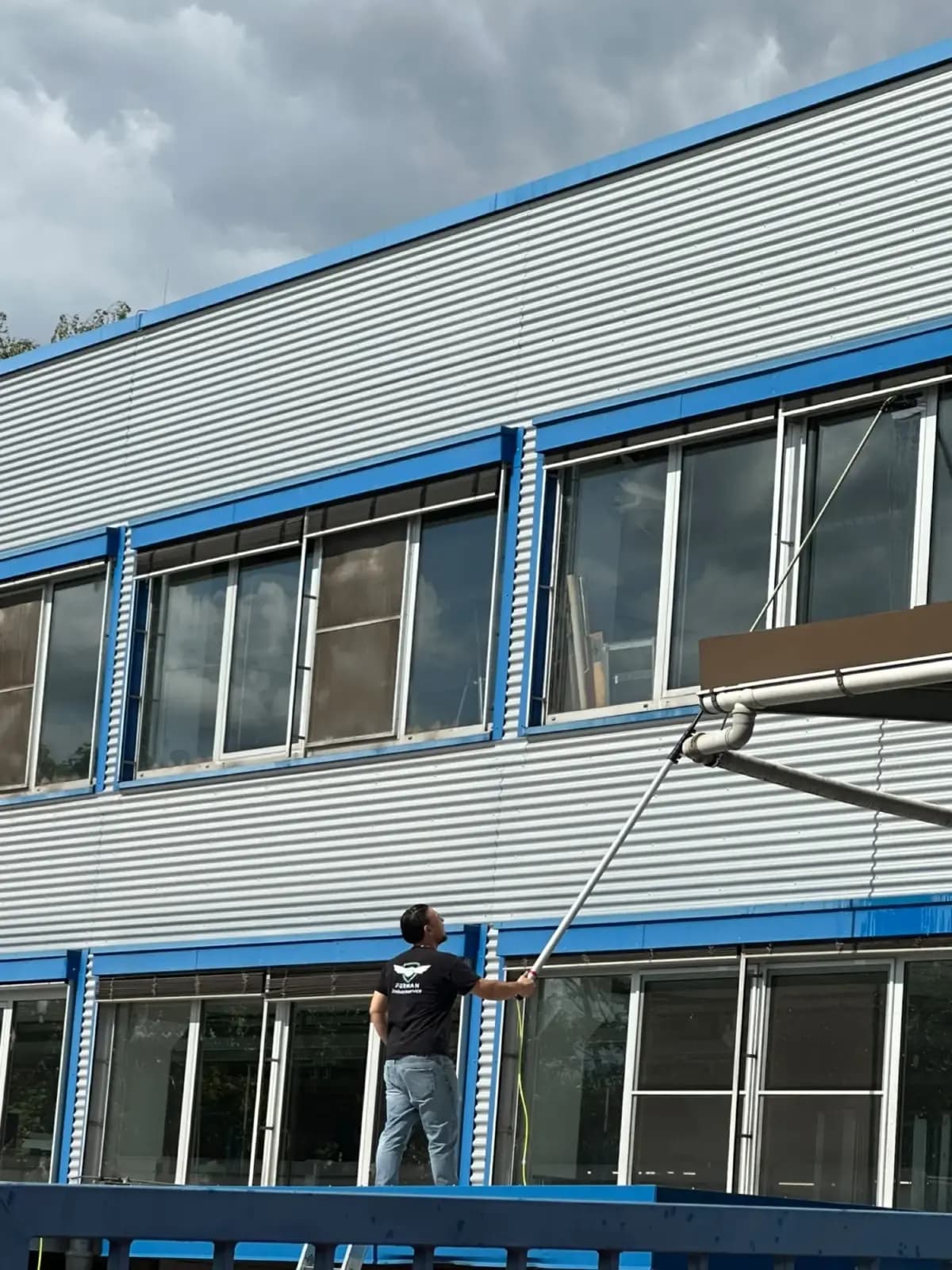
Telescopic poles with osmosis water (up to 12 m)
The most common method for facade windows at normal building height. Carbon or fibreglass telescopic poles with a brush head are operated from the ground, with no climbing and no scaffolding. The osmosis water is pumped through the pole under light pressure and rinses off the dirt. Fast, safe and streak-free.
Aerial work platform / lift (up to 60 m)
For tall facades, hall skylights and glass roofs that cannot be reached from the ground. Lifts provide a stable platform for one person plus equipment. Advantage: no special access needed, quick travel. Limitation: requires sufficient standing space around the building.
Industrial climbers / rope access technique (up to 200 m+)
For extremely tall facades, steep glass roofs or situations with no space for a platform. Industrial climbers secure themselves with rope systems and work systematically from top to bottom. Often impressive to watch from inside, effective and without expensive scaffolding.
Steam cleaning for stubborn deposits
For industrial halls with baked-on oil, grease or resin deposits on glass surfaces. The steam softens deposits, which are then removed completely with a squeegee and osmosis water. Particularly effective for skylights in metalworking or food businesses.
Interior cleaning of glass partitions and display cabinets
For office buildings with glass partitions or exhibition spaces. Antistatic products are used here, which delay dust build-up. Cleaning is carried out with lint-free microfibre cloths.
In-house window cleaning vs. a specialist provider: an honest assessment
Many companies leave window cleaning to their in-house cleaning staff. This works for small, easily accessible window areas, but quickly reaches its limits with industrial requirements.
| Criterion | In-house cleaning | Ferman window and glass cleaning |
|---|---|---|
| Streak-free finish | Hard to achieve without osmosis water and a professional squeegee | Standard, osmosis water dries without limescale marks |
| Access at height | Ladders up to max. 3-4 m, anything higher not permitted without PPE | Telescopic pole up to 12 m, aerial platform up to 60 m, climbers up to 200 m+ |
| Occupational safety | High accident risk with improvised access at height | PPE, fall protection, on-site instruction |
| Liability | Damage to the glass or accidents are at the employer's expense | Service provider is liable for damage and holds liability insurance |
| Efficiency | Slow without professional equipment, ties up your own staff | Fast thanks to professional equipment, less disruption to operations |
Cleaning intervals for glass: recommendations by building and use type
How often glass should be cleaned depends heavily on location and use. As a rule of thumb: urban sites on busy roads need more frequent cleaning than rural office buildings. Production halls with oil or particle emissions in the indoor air need their skylights cleaned more often than ordinary offices.
For industrial halls and production sites in Hesse, we recommend cleaning clerestory windows and side windows at least quarterly. With heavy dust generation (metalworking, woodworking), monthly as well. Office buildings with a prestigious facade: 4-6 times a year for exterior surfaces, interior as needed. Retail shop windows: weekly to fortnightly. Solar systems and photovoltaic modules: twice a year (spring and autumn).
A common mistake: industrial customers clean skylights too rarely because the soiling is not visible from below. Yet the effect is enormous: a skylight that is 30% dirty costs hundreds of euros more per year in energy costs when artificial lighting has to make up the difference. The investment in regular glass cleaning pays off directly.
Glass cleaning quality checklist: what marks professional results
Preparation
- ✓Preliminary site visit to assess height, accessibility and degree of soiling
- ✓Securing the work areas (warning signs, barriers in wet areas)
- ✓Covering sensitive surfaces and floor coverings beneath the glass surfaces
Execution
- ✓Use of osmosis water (below 10 ppm mineral content)
- ✓Systematic approach from top to bottom
- ✓Squeegee technique for streak-free results
- ✓Frames, seals and sills cleaned as well
- ✓Stubborn spots treated with a suitable specialist cleaner
Handover
- ✓Visual check in daylight from at least 3 m away
- ✓Check for streaks, spots and soiled frames
- ✓Photo documentation on request
Author
Tolga Ferman
Owner, Ferman Industrieservice
Practical knowledge from industrial and building cleaning in Hesse. As of: 2026-08-30.
Conclusion
Professional glass cleaning is not a luxury; it is part of preserving the value of your property and has a direct effect on energy costs, employee wellbeing and public image. Ferman Industrieservice cleans glass surfaces in industrial halls, office buildings and special properties throughout Hesse, with osmosis water, its own machinery and trained industrial climbers for any height. Get in touch and we will prepare a non-binding quote for you within 24 hours.
Frequently asked questions
What does professional window cleaning cost in Hesse?+
That depends on height, accessibility and area: office windows can be cleaned quickly from the ground, skylights need an aerial work platform, extreme heights need rope access. Send us photos – you will receive a quote within 24 hours, at a fixed price after a site visit.
How long does it take to clean the glass of a production hall?+
That depends on the window area and the access route. As a guide: approx. 100 m² of glass at normal height with a telescopic pole = approx. 2-3 hours. With an aerial platform for hard-to-reach skylights: correspondingly longer. We calculate realistically after a site visit.
Can glass cleaning be carried out in frost?+
Below 5°C we do not recommend exterior glass cleaning with osmosis water, as the water can freeze on the glass. In the winter months we focus on interior cleaning and schedule exterior cleaning for milder periods.
How often should industrial hall skylights be cleaned?+
With normal use: 2-4 times a year. With heavy dust generation (metalworking, woodworking) or grease emissions: 4-6 times a year. Heavily soiled skylights can lose up to 40% of incoming light, which noticeably increases your need for artificial lighting.
Are industrial climbers really safer than ladders?+
Yes, for heights above 5 m, rope access technique is the safer and legally preferred method in Germany. Climbers work with double securing in accordance with DGUV Regulation 38. Under occupational safety law, ladders above 5 m are permitted for cleaning work only in exceptional cases.
Are special protective treatments applied after glass cleaning?+
On request: yes. After cleaning, we can apply water-repellent lotus-effect sealants that reduce dirt adhesion by 60-70% and extend cleaning intervals. Particularly recommended for hard-to-reach roof windows.
What happens if the glass is damaged during cleaning?+
Ferman Industrieservice holds full business liability insurance. Damage demonstrably caused by our cleaning is settled through our insurance. Before cleaning, we record any existing damage in the site inspection record.