Key points at a glance
- ✓What counts as special cleaning: overview of areas of application
- ✓Work at height: facades, tanks, chimneys
- ✓Emergency cleaning after fire, water, chemical spills
- ✓Was Fachbetriebe übernehmen: Asbest, Schimmel, Tatort
- ✓Legal requirements and certifications
What counts as special cleaning? The most important areas of application
Special cleaning is not a uniform term. It covers a broad range of specialised cleaning tasks that all have one thing in common: they require more than standard cleaning equipment and qualifications.
Height and facade cleaning
Facades, hall walls, industrial chimneys and cooling towers that can only be reached by working platform, scaffolding or rope access. Where platforms cannot be set up, we carry out the work by industrial climbers/rope access.
Tank and container cleaning
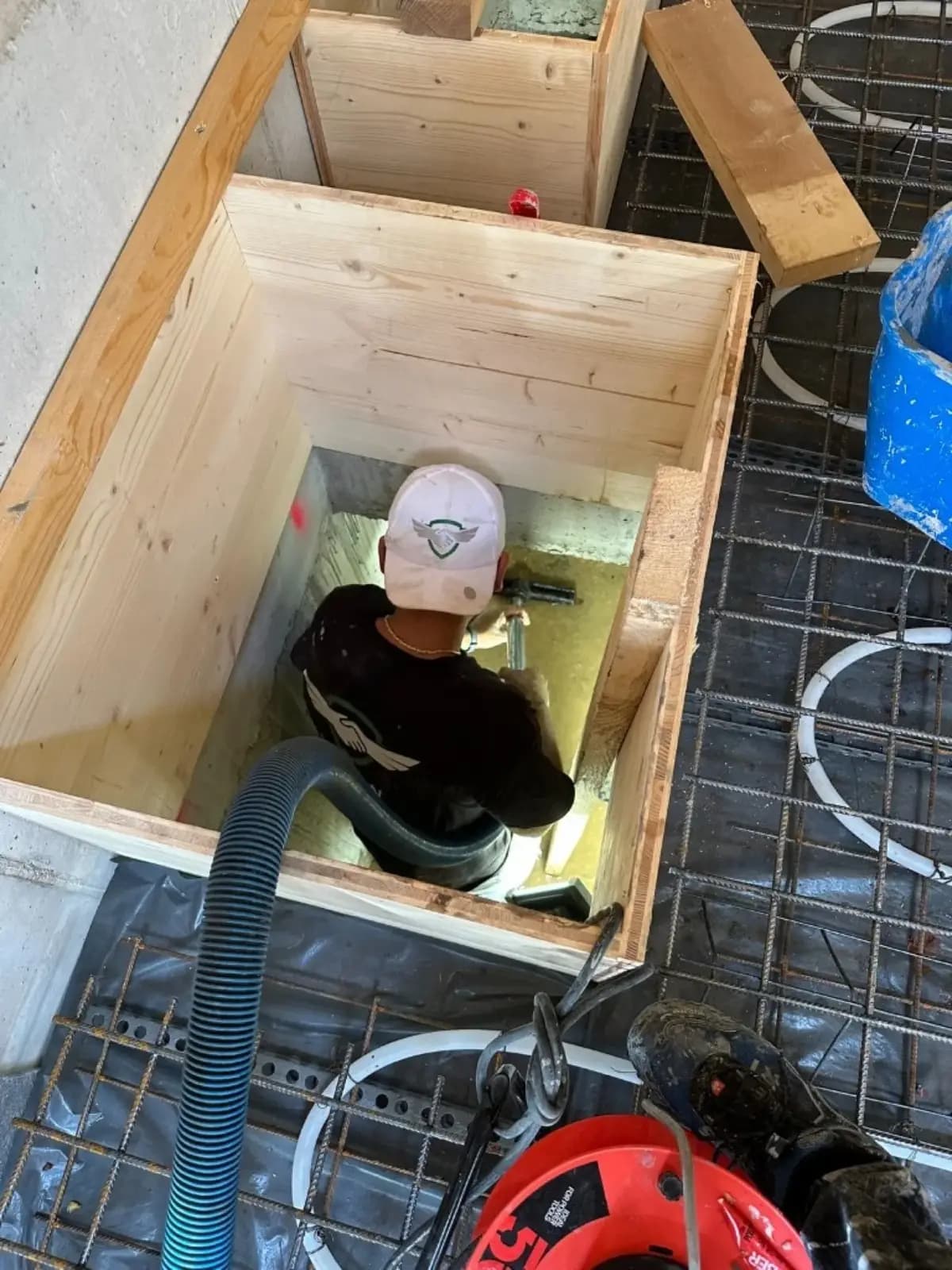
Internal cleaning of heating oil, bitumen, chemical or wastewater tanks. Entering confined spaces requires breathing apparatus, explosion protection and safety personnel outside. Residues are disposed of according to waste code.
Fire damage cleaning
After fires, soot, tar and fire-fighting foam spread across all surfaces. Cleaning must be done quickly (soot eats into surfaces) and requires specialist cleaners and personal protective equipment.
Wasserschadenreinigung
Nach Rohrbruch, Überschwemmung oder Löschwassereinsatz: Feuchtigkeit muss binnen 72 Stunden kontrolliert werden, sonst setzt Schimmelwachstum ein. Wasser absaugen, reinigen, trocknen und dokumentieren. Ist bereits Schimmel entstanden, übernimmt die Sanierung ein darauf spezialisierter Fachbetrieb.
Chemical accident / hazardous substance cleaning
After a release of oils, acids, alkalis or solvents: full protective equipment (PPE level B or C), coordination with a specialist waste disposal company. Documentation in accordance with waste legislation.
Biohazard cleaning
Reinigung nach biologischen Kontaminationen: Tierbefall (Tauben, Nager), Hygienezwischenfälle in Produktionsbereichen. Desinfektionsmittel nach DGHM-Liste, Entsorgung als Sondermüll.
Work at height in special cleaning: facades, tanks and chimneys
Work at height in cleaning is regulated in Germany by DGUV Regulation 38 (work with a risk of falling) and DGUV Rule 112-198 (use of personal protective equipment against falls). From a height of 5 metres, ladders are generally no longer the tool of choice for cleaning work; instead, aerial work platforms, scaffolding or trained industrial climbers using rope access are deployed.
Industrial climbers working with rope access are trained, for example, to the standards of IRATA (Industrial Rope Access Trade Association) or FISAT (Fachverband Industrieklettern und Seilzugangstechnik). For the client, this means: before work begins, clarify how the people deployed are qualified and instructed for work with a risk of falling and which access method suits your site.
For chimneys, cooling towers and silos, further requirements apply in addition to fall protection: confined spaces require gas measurement before entry, respiratory protection and external safety personnel. Such jobs should always be prepared with written operating instructions and a risk assessment.
Emergency response after water damage: the first 72 hours are decisive
With water damage, every hour counts: within 24 to 72 hours of a water leak, mould begins to grow on organic materials. Here is the ideal sequence for professional emergency cleaning:
- 1
Damage assessment and hazard check (hours 1-2)
Check the electrics, assess structural safety, stop the water source. Determine the type of contamination: drinking water (category 1), grey water (category 2) or black water/sewage (category 3), which determines the level of protective equipment and disposal required.
- 2
Water extraction (hours 2-6)
Powerful wet vacuums and submersible pumps remove standing water. Depending on the volume, this can take hours, or up to 24 hours in large halls.
- 3
Moisture measurement and drying plan (hours 6-12)
All affected materials are mapped using moisture meters (contact and non-destructive). Based on the measurements, the necessary drying time and equipment configuration are calculated.
- 4
Setting up drying equipment
Condensation dryers, space heaters and fans are positioned strategically. Aim: air humidity below 50% relative humidity in all affected areas.
- 5
Disinfection of contaminated surfaces
Particularly with category 2/3 water: all surfaces that came into contact are treated with approved disinfectants. Materials that cannot be saved (e.g. heavily soaked plasterboard) are removed.
- 6
Abschlussbegehung und Feuchtemessung
Once fully dry, a moisture measurement confirms release. On request: mould assessment by an accredited laboratory as proof for the insurer.
Asbest, PCB, Schimmel und Tatort: Wer darf was?
Ein Sonderbereich der Sonderreinigung sind Einsätze mit Gefahrstoffen. Am häufigsten relevant ist Asbest: In Deutschland gibt es noch Millionen von Gebäuden mit asbesthaltigem Material (schwach- und starkgebunden). Bei Sanierungs- oder Reinigungsarbeiten können Asbestfasern freigesetzt werden. Die TRGS 519 regelt genau, wer solche Arbeiten durchführen darf, nur Fachbetriebe mit behördlicher Zulassung nach § 6 GefStoffV. Ferman Industrieservice übernimmt Asbest- und Schadstoffsanierung, Schimmelsanierung und Tatortreinigung nicht – dafür sind spezialisierte Fachbetriebe zuständig.
Similar requirements apply to PCB-containing joint sealants (old industrial buildings), PAH-containing adhesives under parquet floors or MPA-containing dispersions. For jobs involving hazardous substances, coordination with approved waste disposal specialists, a risk assessment and a proper waste record are mandatory.
Mineral oil contamination (e.g. tank leaks, hydraulic oil spills) requires quick action: oil binders, collection trays and, in the case of soil contamination, coordination with the local water authority and, where necessary, a soil assessor. We coordinate everyone involved with fixed contacts from a single source.
Special cleaning: what to look for when choosing a provider
Qualification and instruction
- ✓Work at height: access method, qualifications and instruction of the people deployed clarified
- ✓For hazardous substances: instruction of the personnel deployed is demonstrably documented
- ✓Evidence of occupational safety instruction for work in industrial environments
Equipment and safety
- ✓Own PPE (breathing apparatus, protective suits, fall protection)
- ✓Gas detectors for confined-space jobs
- ✓Professional drying technology for water damage
- ✓Disposal partners for hazardous waste
Contract documents
- ✓Full risk assessment before every job
- ✓Operating instruction for hazardous work
- ✓Proof of insurance (liability, accident insurance)
- ✓References from comparable jobs
Author
Tolga Ferman
Owner, Ferman Industrieservice
Practical knowledge from industrial and building cleaning in Hesse. As of: 2026-08-30.
Conclusion
Special cleaning is where false economy is most expensive: water damage that is not professionally treated within 72 hours causes mould damage in the five- to six-figure range. Work at height without suitable securing and instruction can lead to serious accidents and liability consequences. Ferman Industrieservice offers all forms of special cleaning in Hesse and across Germany, with instructed teams, industrial climbers for work at height, suitable technology for every job and an emergency hotline reachable around the clock. Talk to us before the emergency happens.
Frequently asked questions
What does emergency response after water damage cost?+
Emergency jobs after water damage are calculated on the basis of effort: hours, equipment used and drying equipment. After the damage assessment you receive a detailed quote that you can submit to your insurer – on request, we bill the insurer directly.
How quickly is Ferman Industrieservice on site after an emergency?+
We are available 24/7 – including at night, at weekends and on public holidays – and get back to you in under 2 hours. The start of the job depends on the site and situation and is agreed in conversation. Call our emergency number directly: +49 176 623 71841.
How can I tell whether mould has grown after water damage?+
Visible mould is the clear sign. But mould often grows behind walls, under floors and in insulation layers where it cannot be seen. Typical signs: a musty smell, discoloured materials, moisture readings above 80% RH over several days. A mould assessment by an accredited laboratory gives you certainty.
Can any company carry out asbestos cleaning?+
No. For demolition, refurbishment and maintenance work on materials containing asbestos (strongly and weakly bound asbestos products), the contractor needs official approval under § 6 GefStoffV. Without this approval, the work is prohibited, even if it appears to be a 'small cleaning job'.
Can Ferman also carry out special cleaning at night and at weekends?+
Yes. For emergency jobs, of course, but also for plannable special cleaning (e.g. tank cleaning during a plant shutdown, hall refurbishment during the works holiday period) we flexibly schedule jobs for nights and weekends.
What happens to the hazardous substances produced during special cleaning?+
Hazardous cleaning waste (oil-soaked binder, asbestos material, PCB-containing waste) must be correctly packaged, declared as special waste and handed over to an approved waste disposal specialist. This includes a disposal record (accompanying document) for your files.
How does special cleaning differ from normal industrial cleaning?+
Standard industrial cleaning follows a set plan with known cleaning tasks. Specialist cleaning depends on the situation, requires specialised equipment (respiratory protection, rope access equipment, drying equipment) and experienced, instructed teams for hazardous substances or extreme working conditions. The requirements for planning, documentation and safety are correspondingly higher.