Key points at a glance
- ✓Soiled PV modules significantly reduce yield.
- ✓Cleaning in line with manufacturer requirements is crucial for preserving the warranty.
- ✓Demineralised water and specialist brushes ensure scratch-free cleanliness.
- ✓Professional cleaning pays for itself quickly through higher yield.
- ✓Safety and DGUV compliance are the top priority during cleaning.
Why dirty solar modules cost money, yield loss due to soiling, profitability
Every photovoltaic system is a long-term investment designed for maximum electricity production. Yet the surrounding environment constantly poses risks to efficiency. Dirt deposits on the module surface act like a veil that stops sunlight from fully reaching the solar cells. This effect, known as soiling shading, can reduce the energy yield of your system considerably. The yield loss varies depending on location and tilt and is particularly noticeable in industrial or agricultural areas, where dust, pollen and emissions are especially heavy.
Dirty solar modules cost real money: every percentage point of yield loss reduces the value of your annual electricity generation, year after year over the entire service life of the system. This lost income not only cuts the return on investment (ROI) of your PV system but can also extend the payback period considerably. The profitability of your green energy production depends directly on the cleanliness of your modules.
In addition, uneven soiling leads to so-called hotspots. These are overheated areas on the modules caused by uneven current flows due to partial shading. Hotspots can drastically shorten the life of individual cells or entire modules and, in the worst case, even cause irreversible damage. Regular, professional cleaning therefore protects not only your yield but also the physical condition of your entire PV system, safeguards the manufacturer's warranty and optimises the long-term value retention of your investment.
Types of soiling on PV systems, bird droppings, pollen, dust, moss, lichen, industrial soot deposits
The surface of solar modules is exposed daily to a wide range of environmental influences that can show up as stubborn soiling. Every type of deposit impairs light incidence and thus the efficiency of the system. Here are the most common types of soiling encountered by commercial PV systems:
Organic deposits
Bird droppings, leaves, pollen and resin are particularly stubborn. In sunlight, bird droppings literally burn into the surface and often cause permanent hotspots that sharply reduce module output locally.
Mineral soiling
Dust and sand, especially from agricultural or construction environments, form a fine veil. Rain often does not wash these particles away completely but merely spreads them, leading to unsightly streaks that reduce yield.
Biological growth
Moss, algae and lichen find ideal growing conditions on the slightly rough surfaces of the modules, especially in shadier or damper areas. This growth can cover large areas and severely impede light absorption.
Industrial soot deposits
Near industrial plants, roads or combined heat and power stations, solar modules are often exposed to soot, oil or fine dust particles. These form a sticky film that is hard to remove and leaves the module permanently and heavily soiled.
Manufacturer-compliant cleaning, what the manufacturer requires, what puts the warranty at risk
Following the manufacturer's specifications is of the utmost importance when cleaning your photovoltaic system. Improper cleaning can not only impair the performance of your modules but also lead to loss of the manufacturer's warranty. Ferman Industrieservice ensures that all cleaning work is carried out strictly in line with the module manufacturers' specifications.
| Criterion | Without cleaning | With annual cleaning |
|---|---|---|
| Module surface | Scratches, micro-cracks from abrasive particles, residues | Smooth, undamaged, maximum light transmission |
| Warranty claim | At risk or void if cleaned improperly by yourself | Remains intact if cleaned according to the module manufacturer's specifications |
| Water quality | Tap water leaves limescale marks and mineral deposits | Demineralised water for residue-free drying |
| Cleaning agents | Aggressive chemicals attack the module coating | No chemical additives, only pure water |
| Pressure/tools | High-pressure cleaners or hard brushes cause damage | Low-pressure methods, soft specialist brushes, gentle handling |
| Long-term effect | Premature ageing, hotspots, performance degradation | Module performance preserved, longer service life |
Cleaning technology in detail, demineralised water, soft brushes, low-pressure methods, no scratches
Professional PV system cleaning differs fundamentally from conventional cleaning methods. At the heart of our technique is the use of demineralised, i.e. fully deionised, water. This special water is free of minerals, limescale and other dissolved substances that could leave unsightly marks or even microscopic deposits as it dries. The benefit: after cleaning, the modules dry spot-free and streak-free, with no need for wiping or for aggressive chemicals that could damage the sensitive module surface.
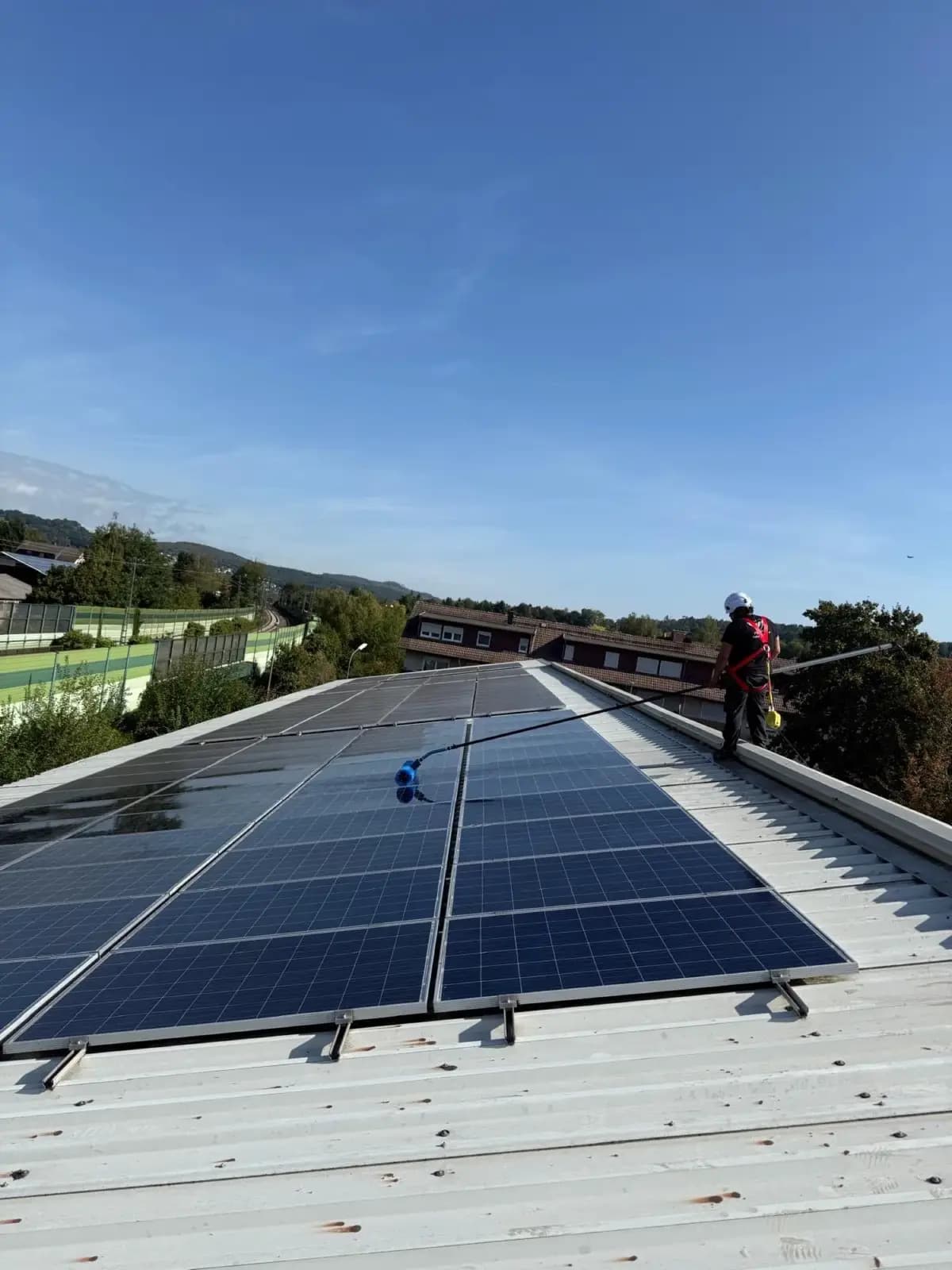
Another decisive factor is the tools used. We rely exclusively on soft specialist brushes developed specifically for cleaning solar modules. These brushes are designed to loosen even the most stubborn soiling effectively without scratching the sensitive anti-reflective coating or the glass of the modules. The contact pressure is always kept as low as possible. Combined with low-pressure cleaning methods, often using telescopic poles or special cleaning robots, we ensure gentle yet extremely thorough cleaning that preserves the integrity of your system 100%.
The combination of demineralised water and soft specialist brushes, applied with low-pressure methods, is the key to cleaning that complies with manufacturer requirements and causes no damage. This precise technique not only prevents scratches and micro-cracks that could reduce performance and jeopardise the warranty, but also ensures that your modules regain their full transparency, and therefore maximum energy absorption, after cleaning. Ferman Industrieservice continuously invests in state-of-the-art technology and training to maintain this high standard and secure the longevity of your PV system.
Calculating yield gains, ROI of PV cleaning, payback, monitoring integration
Professional PV system cleaning is not an expense but an investment that pays off. Determining the return on investment (ROI) and the payback period is crucial for your budget planning. Ferman Industrieservice helps you make this added value transparent.
Establishing the baseline
Before we clean, we analyse your system's current yield data. By comparing it with expected values or reference systems, the current yield loss caused by soiling can be quantified, often 10-20%.
Cost-benefit analysis
We prepare a detailed cost calculation for the cleaning. Alongside it, we set out the expected yield increase for your specific system. This comparison makes the direct financial benefit visible.
Calculating ROI
The ROI of PV cleaning is easy to calculate: (annual yield increase − cleaning costs) / cleaning costs. The cleaning costs often pay for themselves within a few months of the first clean.
Payback period
The payback period shows you when the investment in cleaning has been fully recouped. With a yield increase of 15%, for example, and annual cleaning costs, this is often the case within a year.
Monitoring integration
We recommend closely monitoring your system's performance data before and after cleaning. Modern monitoring systems visualise the yield increase and prove the success of the measure in black and white. This is an important aspect of quality assurance.
Safety on the roof, DGUV, PPE, fall protection, specialist company vs. doing it yourself
Working on roofs and at height involves considerable risks and is subject to strict regulations in a commercial setting. The German Statutory Accident Insurance (DGUV) and the Workplace Ordinance (ArbStättV) set clear requirements for safety in such work. This includes providing personal protective equipment (PPE) such as helmets, safety shoes and special fall-protection equipment. A specialist company such as Ferman Industrieservice is not only trained in using this equipment but also obliged to carry out regular inspections and maintenance of the safety equipment in order to ensure the highest safety standards.
Fall protection is a key aspect of any roof work. This includes not only fall-arrest systems but also collective protective measures such as scaffolding or temporary guard rails, wherever technically feasible. A professional service provider such as Ferman Industrieservice has the necessary know-how and equipment to install and use these safety systems correctly. A risk assessment before every job is standard practice, so that potential hazards are identified and eliminated before work begins. This duty of care protects not only our employees but also your company from liability risks.
The comparison between hiring a specialist company and doing the work yourself has a clear outcome. Carrying out PV cleaning in-house may seem cheaper at first glance, but it carries immense risks. Besides the danger of personal injury due to inadequate fall protection or insufficient PPE, there is also a risk of damage to the system through improper cleaning. A specialist company brings not only the expertise and the right equipment but also the necessary insurance cover and certifications that protect you from unpleasant surprises. Ferman Industrieservice ensures safe and effective cleaning of your system.
The right timing, spring cleaning, after hail, recommended intervals by location and system
The optimal time to clean your photovoltaic system depends on various factors. Strategic planning not only maximises yield but also extends the life of your modules. Here are the key considerations and recommendations:
- 01
Spring cleaning
Ideally, the first clean of the year should take place in spring. After the winter months, pollen, dust, bird droppings and other deposits often accumulate. Cleaning before the start of the main season secures maximum yields in the sunniest months.
- 02
After special events
After extreme weather events such as heavy storms, hail or prolonged dry spells with a lot of dust, an additional clean is advisable. After construction work near your system, a special clean can also make sense to remove cement haze or construction dirt.
- 03
Location-dependent intervals
How often to clean depends heavily on the location. Systems in agricultural areas (pollen, dust, ammonia), near industry (soot, fine dust) or busy roads often need 1-2 cleans per year. In urban areas, an annual cycle may be enough.
- 04
System-dependent factors
The tilt of the modules plays a role: shallower tilt angles (e.g. on flat roofs) encourage heavier soiling because the self-cleaning effect of rain is weaker. The type of module (e.g. rough surfaces) can also influence cleaning intervals.
- 05
Monitoring as an indicator
Use your system monitoring! A sudden or gradual drop in performance that cannot be explained by the weather can be a clear sign that cleaning is needed. A professional analysis of the yield data helps find the optimal time.
Large commercial systems, flat roof, pitched roof, ground-mounted systems, carports
Cleaning large commercial systems poses particular challenges that go beyond those of private rooftop systems. Whether on the expansive flat roofs of production halls, the pitched roofs of warehouses, extensive ground-mounted systems or integrated solar carports, each type of system requires specific approaches and adapted cleaning techniques. Ferman Industrieservice has the necessary experience and equipment to clean even the most complex large systems efficiently and safely, even under demanding conditions such as night or weekend shifts, so that your operations are not disrupted.
On flat-roof systems, access is often easier, but dirt builds up especially quickly because the self-cleaning effect of rain is weaker. Our teams specialise in working through these areas methodically and thoroughly, always paying attention to the load-bearing capacity of the roof and the correct way to walk the module rows. Pitched-roof systems, on the other hand, require professional fall protection and special cleaning systems that allow safe and effective cleaning even on steeper pitches. DGUV regulations are rigorously observed here to ensure maximum safety for everyone involved.
Ground-mounted systems and solar carports, in turn, require mobile, large-area cleaning systems. Special vehicles or robots that can clean large module areas in a short time are often used here. Whatever the type of system, our aim is always to deliver the highest quality and keep to deadlines. Ferman Industrieservice offers you a cleaning solution tailored to your business and matched exactly to the conditions of your large commercial system, to ensure maximum yields and a long service life for your photovoltaic investment.
Cost of PV cleaning, price factors, cost per module/m², ROI table
Price factors for PV cleaning
- ✓System size: Larger systems often benefit from economies of scale, so the price per module or square metre can fall.
- ✓Degree of soiling: Heavily soiled systems require more intensive effort and possibly longer cleaning times.
- ✓Accessibility: Easily accessible roofs or open ground are cheaper to clean than systems with complex safety requirements or hard-to-reach modules.
- ✓Module type and tilt: Special module types or very shallow tilt angles can affect the effort involved.
- ✓Regional conditions: Travel distances and specific environmental requirements can have a marginal effect on costs.
A quote for your system
- ✓Costs depend on module area, tilt, access (roof or open ground) and soiling. With photos and the system size you will receive a quote within 24 hours – so you can see straight away whether cleaning pays off for your system.
- ✓Alternatively, pricing can be calculated per module, with prices varying depending on module size and the factors mentioned above.
- ✓For tailored quotes, an on-site inspection or a detailed description of the system is necessary.
- ✓After the site visit you receive a fixed-price quote, usually within 24 hours.
How to calculate the benefit of cleaning
- ✓Annual yield of your system from monitoring (kWh).
- ✓Yield loss due to dirt: comparison of output before and after a cleaning, or with clean reference modules.
- ✓Value of the additional yield: yield difference × your electricity price or feed-in tariff.
- ✓Your comparison: set the additional yield against our quote – we are happy to work through it with you.
Author
Tolga Ferman
Owner, Ferman Industrieservice
Practical knowledge from industrial and building cleaning in Hesse. As of: 2026-08-30.
Conclusion
A clean photovoltaic system is the key to maximum yields and a long service life for your investment. Professional photovoltaic cleaning by Ferman Industrieservice secures more stable yields for you and protects your warranty and the substance of your modules. With demineralised water, gentle specialist brushes and strict compliance with all safety regulations, we ensure cleaning that is effective and in line with manufacturer requirements. You work with a partner that puts punctuality, quality and safety first, including at night or at weekends. Contact Ferman Industrieservice today for an individual quote and optimise the performance of your PV system in Hesse – for large solar parks also across Germany. Visit our service page for more information: ferman-industrieservice.de/leistungen/photovoltaik-anlagenreinigung
Frequently asked questions
How often should a commercial PV system be cleaned?+
The optimal cleaning frequency depends heavily on your system's surroundings. In industrial or agricultural areas, where dust, pollen and emissions are high, we recommend one to two cleans per year. For systems in less exposed locations, an annual cycle may be sufficient. A spring clean is usually necessary, however, to remove the deposits of winter and prepare the system optimally for the high-yield summer months. We are happy to advise you individually based on a site analysis.
What are the risks of improper cleaning?+
Improper cleaning carries considerable risks. These include scratches and micro-cracks on the module surface from hard brushes or abrasive cleaning agents, which permanently reduce performance and can cause hotspots. Using tap water leads to limescale marks that reduce light transmission. In the worst case, cleaning that does not comply with the manufacturer's requirements can lead to loss of the manufacturer's warranty. In addition, working on the roof without appropriate fall protection and PPE is extremely dangerous and violates DGUV regulations, which can raise liability issues.
Can we carry out the cleaning ourselves?+
We strongly advise against cleaning your commercial PV system yourself. Apart from the safety risks (risk of falling, DGUV regulations), you usually lack the specialised equipment and know-how. Standard cleaners and brushes can damage the modules, and tap water leaves limescale marks. A specialist company such as Ferman Industrieservice has trained personnel, demineralised water, special brushes and the necessary safety equipment to ensure gentle, effective cleaning that complies with manufacturer requirements and protects your warranty.
What cleaning technique is used?+
Ferman Industrieservice uses only professional cleaning techniques that comply with manufacturer requirements. At the core is the use of demineralised (fully deionised) water. This water leaves no limescale marks or residues. We also use soft specialist brushes developed specifically for cleaning sensitive solar module surfaces. Cleaning is carried out at low pressure to avoid any damage such as scratches or micro-cracks. Aggressive chemicals are strictly off limits. This method ensures thorough cleanliness and preserves the integrity of the modules.
How is Ferman Industrieservice qualified for PV cleaning?+
As an experienced B2B provider of industrial services, Ferman Industrieservice places the greatest importance on quality and safety. Our teams are instructed in PV cleaning techniques and in the safe handling of the equipment. We work strictly in line with the module manufacturers' guidelines and the DGUV regulations on occupational safety. Although there is no single, overarching ‘PV cleaning certification’, our internal quality standards, work in line with manufacturer guidelines and our many years of experience ensure the professionalism of our service. We provide evidence on request.
How is the quality of the cleaning ensured?+
At Ferman Industrieservice, quality assurance begins before the job even starts, with detailed planning and risk assessment. During cleaning, our experienced teams monitor the process closely to ensure complete and gentle cleaning of all modules. Once the work is finished, a final visual inspection is carried out. If needed, and in consultation with you, we can also recommend a performance analysis before and after cleaning using your monitoring system, to document the achieved yield increase objectively. Our aim is always your complete satisfaction and maximum system performance.
Does Ferman Industrieservice also offer other services for PV systems?+
Ferman Industrieservice is your partner for a wide range of industrial services. While our core competence is PV system cleaning, as part of our industrial services we also offer related services that are relevant to the smooth operation and upkeep of your commercial buildings. These include, for example, facade cleaning or general industrial cleaning. Feel free to get in touch to find out how we can support you beyond this and what synergies could arise for your company. We find tailored solutions for your requirements.