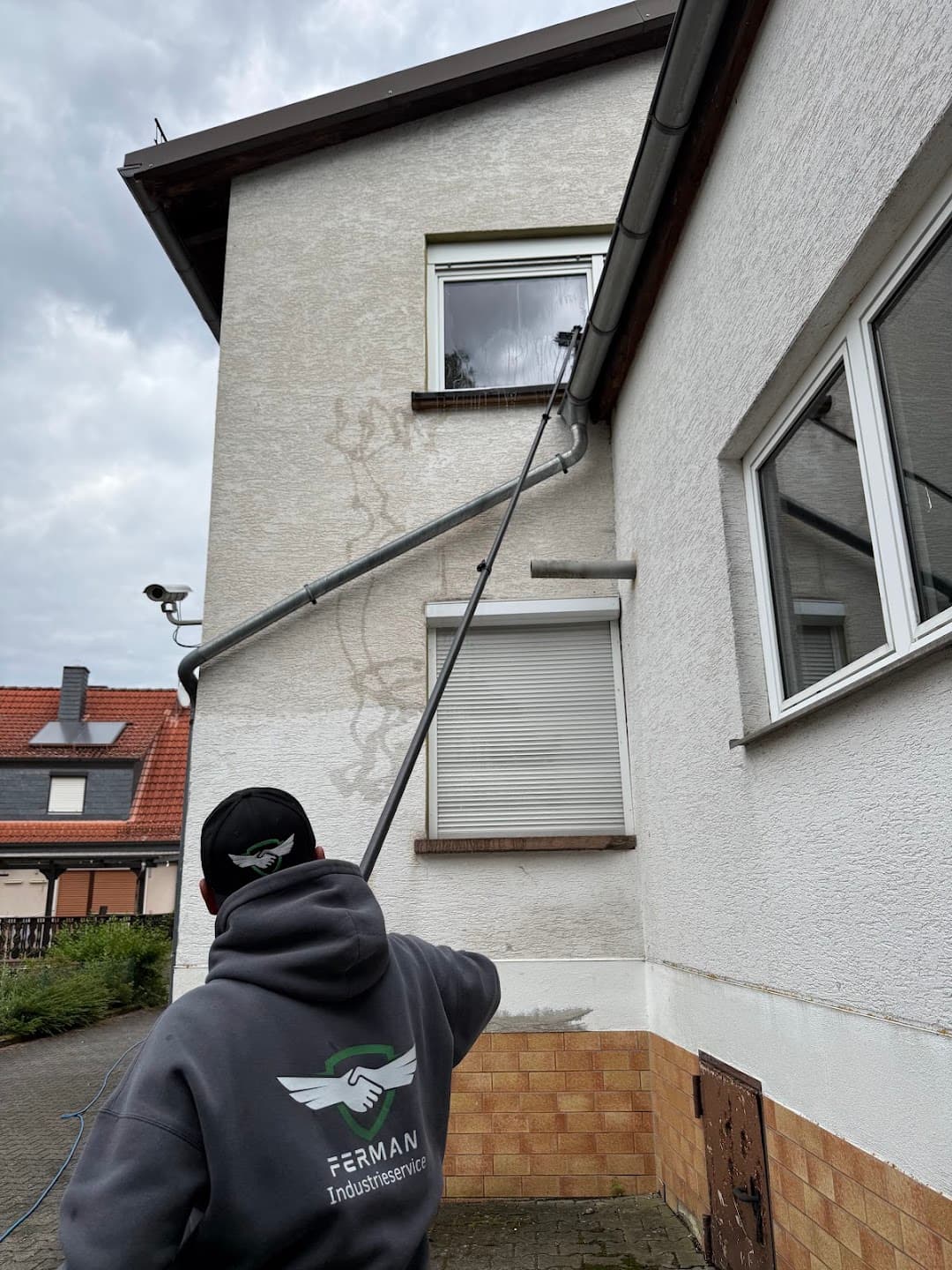
Osmosis pure-water window and glass cleaning
Streak-free window and glass cleaning with osmosis pure water, the modern method for perfectly clean windows, glass façades and skylights. No chemicals, no polishing afterwards, with long-lasting results.
What is osmosis pure water?
Osmosis pure water is fully demineralised water produced by reverse osmosis. This removes all minerals, salts and impurities from the water. The result: 100% pure H₂O without any residues.
When drying, osmosis pure water leaves no limescale spots, smears or streaks, unlike ordinary tap water. That is why it is the ideal medium for professional window and glass cleaning.
The process works entirely without cleaning chemicals. The pure water dissolves dirt through its physical properties and is applied with special telescopic poles and brushes.
Advantages of the osmosis pure-water method
Streak-free
No limescale spots, no smears, perfectly clean glass surfaces without polishing afterwards.
Chemical-free
100% environmentally friendly: no cleaning agents, no residues, no burden on the environment.
Long-lasting
Glass stays clean for longer, as no residues are left behind to attract dirt.
Great heights
With telescopic poles up to 20m in height, without an aerial platform or scaffolding.
Our equipment: mobile osmosis system with up to 410 litres per hour
For glass, façades and photovoltaics we use a mobile reverse osmosis system with two high-pressure membranes. It treats tap water on site, chemical-free, into pure water, and two teams can work with telescopic poles at the same time. In addition we have the complete accessories for windows, glass surfaces, façades and PV systems: telescopic poles, brushes and attachments for every surface.
- 410 l/h
- Pure water up to
- 2 membranes
- High-pressure reverse osmosis
- ≥ 95 %
- Salt rejection, measured on site
- 2 poles
- can be connected simultaneously
Osmosis pure-water technology explained
Ordinary tap water contains between 200 and 600 mg/l of dissolved minerals, depending on the region: calcium, magnesium, sodium, chlorides. After drying, these minerals remain as whitish residues on glass surfaces and form the familiar limescale spots and smears.
In reverse osmosis, tap water is forced under pressure through a semipermeable membrane. This membrane lets only water molecules pass; all dissolved salts, minerals and organic impurities are held back. The result is largely demineralised pure water: our system retains at least 95 % of the dissolved salts, a value we measure on site with the built-in TDS meter (tap water: 300–800 µS/cm).
This pure water has a natural affinity for minerals and dirt particles and actively draws them out of the surface. When drying, it evaporates without residue, as it no longer contains any minerals.
Osmosis water vs. tap water: comparison
| Property | osmosis pure water | Tap water |
|---|---|---|
| Conductivity | at least 95 % less salt | 300-800 µS/cm |
| Limescale residue | None | Yes |
| Polishing afterwards needed | No | Yes |
| Chemicals required | No | Usually yes |
| Cleanliness afterwards | Stays clean longer | Shorter |
Areas of application in detail
Office buildings & administrations
Glass façades, entrance areas, atriums and large window fronts are the calling card of modern office buildings. With osmosis pure water and telescopic poles up to 20 m in height, we clean these surfaces professionally, streak-free and without an aerial platform. This saves effort and costs, and the building once again makes a well-kept impression.
Industrial halls & skylights
Hall windows, light bands and skylights in production halls often go uncleaned for years, being too difficult to access and too laborious to clean with conventional methods. Dirty skylights considerably reduce the incoming light and impair working conditions. Osmosis pure water with long telescopic poles reaches these surfaces from the ground, safely, efficiently and without scaffolding.
Production sites & cleanrooms
Viewing windows on machines, cleanroom airlocks, control areas with glass partitions and hygiene-sensitive glass surfaces in the food or pharmaceutical industry benefit particularly from chemical-free cleaning with osmosis water. No cleaning agent residues, no contamination, ideal for GMP- and HACCP-compliant environments.
Conservatories, glass roofs & carports
Sloping glass surfaces, glass roofs and conservatories are particularly prone to algae, moss and limescale deposits. Osmosis pure water combined with suitable brushes removes these deposits gently and leaves no smears, even on lightly tinted or coated glass.
Window and glass cleaning with osmosis water in Hesse
Ferman offers osmosis window and glass cleaning for industrial and commercial businesses throughout Hesse: Frankfurt, Wiesbaden, Darmstadt, Gießen, Kassel, Fulda and the surrounding areas. The tap water in the Rhine-Main region has a comparatively high limescale content, which makes the difference of the osmosis method all the more noticeable. Contact us for a free initial assessment.
Frequently asked questions about osmosis window and glass cleaning
How does cleaning with osmosis water work?▼
The fully demineralised pure water is applied to the glass surface with special brushes. The brushing action actively loosens dirt, and the pure water has a strong pull on minerals and dirt particles. The glass is then rinsed with clear pure water. It dries streak-free by itself, as the water contains no minerals.
Is the method also suitable for heavily soiled windows?▼
Yes. For very heavy soiling (algae, moss, building-site dust, grease stains), pre-cleaning with biodegradable cleaners or high-pressure water can be carried out before the osmosis water treatment. For normal operational soiling, the pure water alone is sufficient.
How high can you clean with osmosis telescopic poles?▼
With modern carbon-fibre telescopic poles we reach heights of up to 20 metres, which corresponds to about 6-7 storeys. For greater heights we combine the osmosis method with industrial climbers or aerial work platforms.
How often should cleaning with osmosis pure water be carried out?▼
Recommended: 2-4 times a year, depending on location and degree of soiling. Industrial operations near roads, production plants or in agriculture need more frequent cleaning. As osmosis water leaves no residues, the glass stays clean significantly longer after cleaning than after conventional cleaning.
Is osmosis window and glass cleaning environmentally friendly?▼
Yes. No chemical glass cleaner is used, only pure water. This protects the environment, groundwater and building greenery. The osmosis membrane itself is also long-lasting and produces no significant waste.
Can you also clean coated or tinted glass?▼
Yes. Osmosis water is non-abrasive and contains no chemicals that could attack coatings. We use soft brushes and avoid hard scrapers, so even thermal insulation glass, solar control coatings and lightly tinted glass can be cleaned safely.
Other methods
Next step
Request a free quote
Briefly describe your needs. We are available 24/7, reply in under 2 hours and send your quote within 24 hours, often sooner.