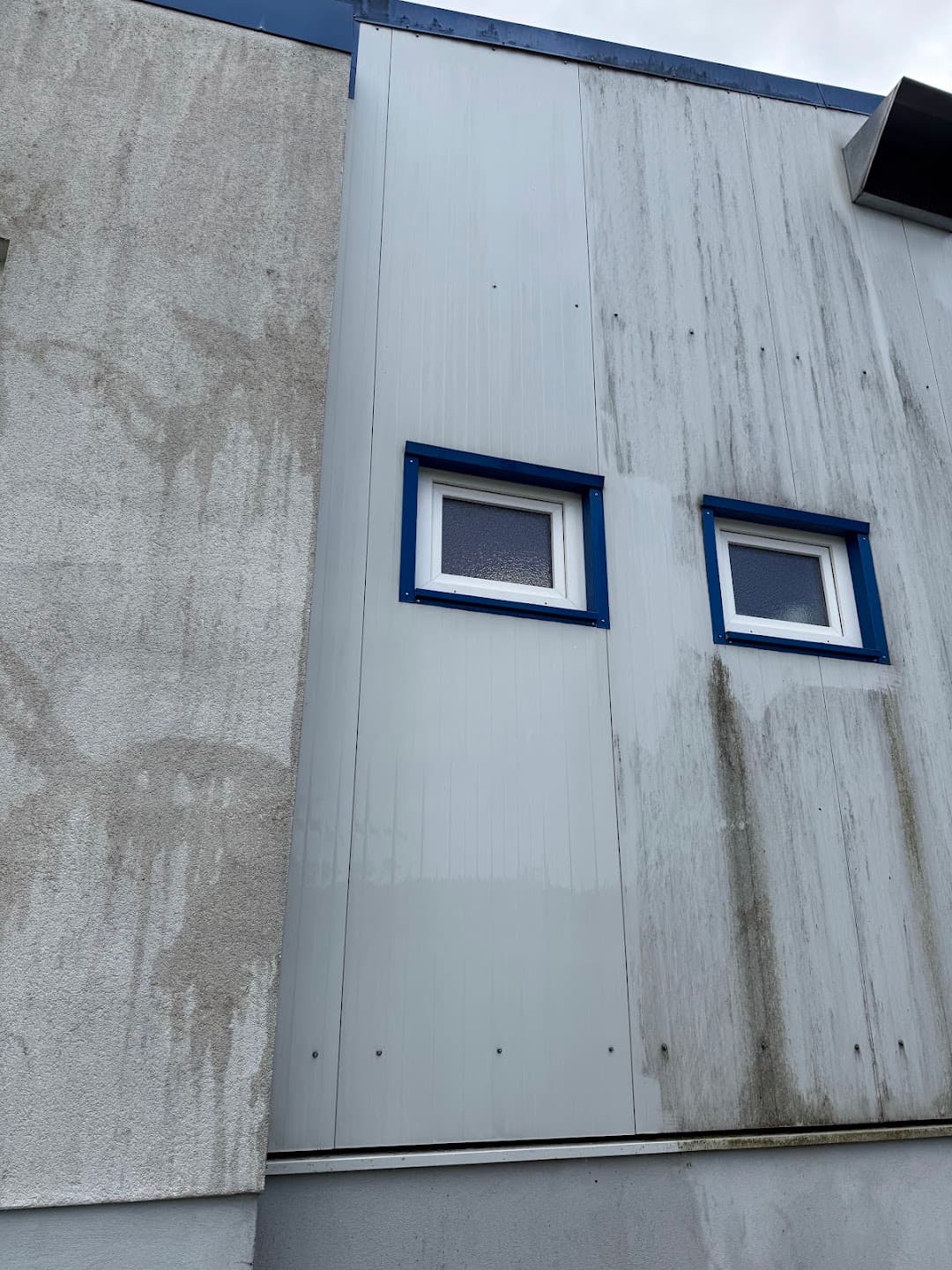
Industrial climbers: work at height
Professional work at height by industrial climbers, for jobs where scaffolding, aerial work platforms or cranes are uneconomical or impossible. Fast, flexible and cost-effective.
What are industrial climbers?
Industrial climbers are specially trained specialists who work at great heights using rope access techniques. They carry out cleaning, maintenance, inspection and installation work that would otherwise only be possible with elaborate scaffolding or aerial work platforms.
The method is particularly efficient in areas that are hard to reach: façades, silos, chimneys, bridges, industrial plant. In Germany, industrial climbers are usually trained to FISAT (Fachverband für Seil- und Sicherheitstechnik) or IRATA (Industrial Rope Access Trade Association) standards.
Highest safety standards: redundant safety systems, regular training, tested equipment. Every job is carried out in accordance with strict safety protocols.
Advantages of rope access
Cost-effective
Often more economical than scaffolding or a cherry picker – with no set-up or dismantling time.
Fast
No erecting or dismantling of scaffolding, ready for use immediately.
Flexible
Access to hard-to-reach areas without restrictions.
Safe
Experienced climbers, redundant safety systems, tested equipment. Proof of qualifications on request.
Training & certification of industrial climbers
Industrial climbers are not ordinary workers at height; they complete multi-stage, internationally recognised training in rope access. The two most important certification systems are:
FISAT
Fachverband für Seil- und Sicherheitstechnik e.V., the standard German certification system for industrial climbers. Levels: FISAT Grade 1 (work under supervision), Grade 2 (independent work), Grade 3 (supervision and planning). Regular recertification every 3 years.
IRATA
Industrial Rope Access Trade Association, the international standard for rope access, recognised worldwide. Three levels (I, II, III) with increasing requirements. Preferred in the international industrial and energy sectors.
In addition to their climbing training, industrial climbers must know all relevant occupational safety rules: DGUV Rule 101-006 (safety rules for rope access), fall protection under the German Ordinance on Industrial Safety (BetrSichV) and EN 363. Our climbers receive regular safety briefings; we clarify in advance which evidence your job requires – evidence is available on request.
Areas of application in detail
Façade cleaning at great heights
Industrial climbers are the most cost-efficient solution for cleaning façades from 10 m in height. Glass façades, clinker brick, natural stone, metal and composite façades: depending on the material, we combine high-pressure cleaning, osmosis pure water or chemical cleaning with the climbing method. Scaffolding and aerial work platform costs are eliminated entirely.
Maintenance & inspection of industrial plant
Chimneys, silos, storage buildings, wind turbines, bridges and steel structures must be inspected and maintained regularly. Industrial climbers reach all areas safely and quickly, without elaborate preparation. Visual inspections, documentation of damage, minor repairs and sealing work are possible as part of a single job.
Assembly & installation work
Lighting installations, company signs, security cameras, fall protection systems (anchor points, railings) and fixings are often installed at great heights. Industrial climbers carry out this work without the need to erect scaffolding. Depending on the project, this saves several thousand euros in scaffolding costs.
Roof & gutter work
Cleaning gutters, removing moss, cleaning roof surfaces, checking roof penetrations and carrying out minor sealing work: all jobs that arise regularly and can only be done safely from above. Industrial climbers do this without elaborate scaffolding, even on pitched or flat roofs that are hard to access.
Industrial climbers vs. scaffolding: cost & time
| Criterion | industrial climbers | Scaffolding | Aerial work platform |
|---|---|---|---|
| Costs | Low-cost | High | Medium-high |
| Set-up time | None | Days to weeks | Hours |
| Space required | Minimal | High | Medium |
| Accessibility | Very flexible | Limited | Limited |
| Max. height | Unlimited | Project-dependent | Up to ~60 m |
Industrial climber jobs in Hesse
Ferman carries out work at height with industrial climbers throughout Hesse and across Germany: Frankfurt, Wiesbaden, Darmstadt, Offenbach, Gießen, Kassel, Fulda and the surrounding areas. Our industrial climbers are in particular demand for:
Frequently asked questions about industrial climbers
Are industrial climbers insured?▼
Before any work at height, ask about liability and accident insurance. We provide proof of insurance on request.
What height can industrial climbers work at?▼
In principle there is no technical height limit with rope access. Our climbers regularly work at heights from 20 to over 100 metres. Actual feasibility depends on the property, the anchoring options on the building and the wind conditions, which we clarify in the preliminary site visit.
How much cheaper are industrial climbers compared with scaffolding?▼
Industrial climber jobs are in many cases significantly cheaper than scaffolding solutions. The biggest advantage lies in eliminating the time to erect and dismantle scaffolding, as well as the scaffolding material itself. Individual quote on request.
Is the method also possible in wind?▼
Working on the façade is possible up to a wind speed of approx. 60 km/h (wind force 7). In stronger wind or gusts, work is paused for safety reasons. We assess the weather conditions daily and adjust the job accordingly.
What permits do industrial climbers need?▼
In most cases no official permits are required, as no public traffic areas have to be closed. For work above public paths or pavements, a short-term cordon may be required. We clarify any permit requirements as part of project planning.
Can industrial climbers also work at night or at weekends?▼
Yes. On request we schedule work at height outside core operating hours, at night or at weekends. This is particularly advantageous for operations that keep running, where no work is possible during the day. Talk to us about your requirements.
Next step
Request a free quote
Briefly describe your needs. We are available 24/7, reply in under 2 hours and send your quote within 24 hours, often sooner.